The Byzantine frescoes
Painting and a marble iconostasis of the eleventh century.
C messier — CC BY-SA 4.0 · Olaf Tausch, perspective corrected by User:H-stt — CC BY 3.0 · Balou46 — CC BY-SA 4.0 · Balou46 — CC BY-SA 4.0
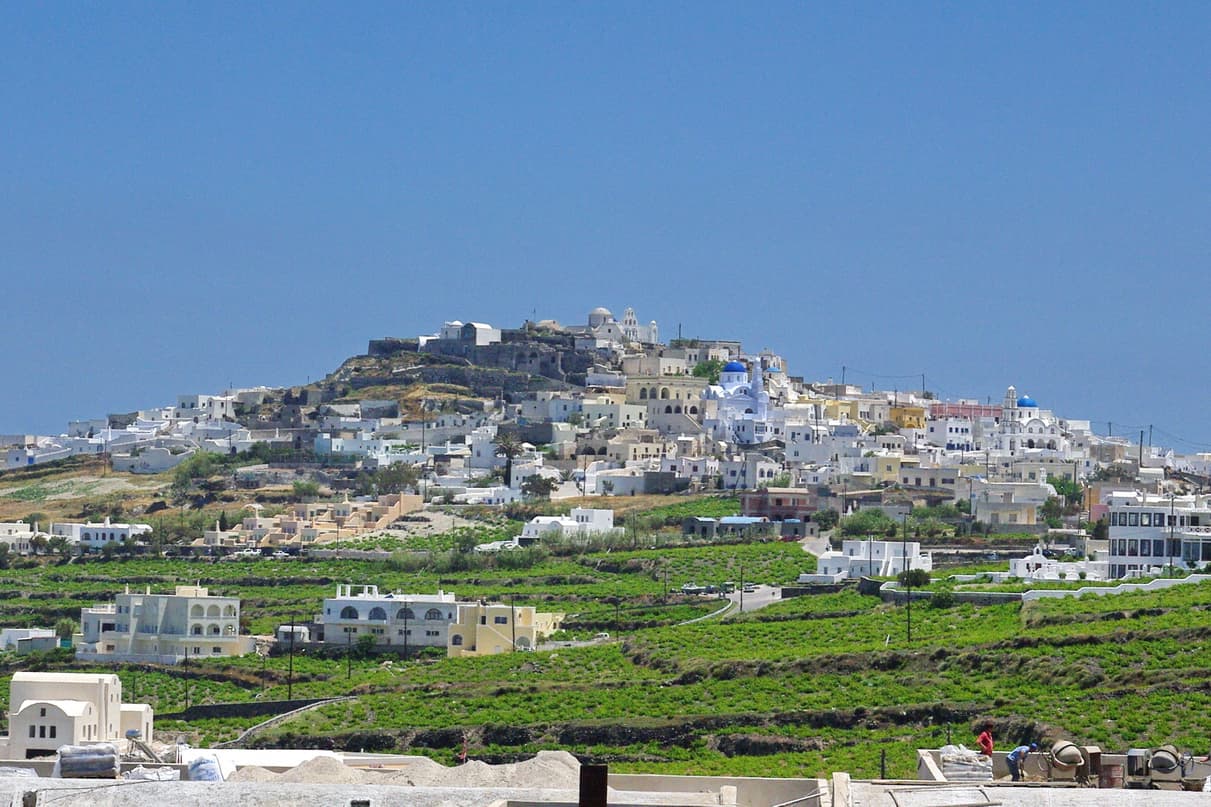
**The oldest standing building on Santorini** and its most important Byzantine church: built in the **eleventh century** on the order of the Byzantine emperor **Alexios I Komnenos**, and standing ever since — including through the devastating **1956 earthquake** that flattened half the island. It is small and solid, of volcanic stone with a low dome, and looks nothing like the polished white churches of the caldera: **bare stone**, thick walls and heavy arches — architecture built to last rather than to be photographed. Inside are **Byzantine wall paintings** and a carved marble iconostasis of the same period, with old icons. The air is cool, silent and relatively dark. Around it lies the village of **Mesa Gonia**, abandoned by its people after the 1956 earthquake and left in ruins for decades, part of it restored in recent years — and you walk between the two. ⚠ It is **inland**, away from the usual visitor route, and so is almost always empty.
Painting and a marble iconostasis of the eleventh century.
Thick volcanic building, unlike the caldera churches.
A village abandoned after the 1956 earthquake, partly restored.
Episkopi Gonias, Mesa Gonia, 84700 Santorini
A powerful earthquake struck the island of **Amorgos** and the southern Aegean in **July 1956**, causing enormous damage on Santorini: much of the island's building stock collapsed, **Oia and Fira** were badly hit, the rim cracked, dozens were killed and thousands made homeless. **Many residents emigrated** to Athens and abroad and never returned, leaving whole villages in ruins for decades — among them **Mesa Gonia** around this church. The island did not recover economically until the tourism wave from the 1970s onward, when Oia was rebuilt and the abandoned parts restored. So the Santorini you see was **rebuilt within a single lifetime**.
It is at **Mesa Gonia** inland between Fira and Kamari, on a side road — **use a map**, as it is not signposted prominently and bus service is poor; a car or taxi is safer. ⚠ Its **hours are irregular**: it is a small parish church rather than a visitor site, opening mostly in the **morning** and around services, and you may find it shut with no stated reason. The advice: call in on your way to Kamari or Ancient Thera in the morning, rather than driving out specially in the evening.