Longer than the Great Wall
The total dry stone walling built by farmers by hand.
Bernd Gehrmann — CC BY-SA 3.0 · This Photo was taken by Timothy A. Gonsalves. Feel free to use my photos, but please mention me as the author. I would much appreciate if you send me an email tagooty@yahoo.com or write on my talk pag — CC BY-SA 4.0 · The Cosmonaut — CC BY-SA 2.5 ca · marcocastagna — CC BY-SA 4.0
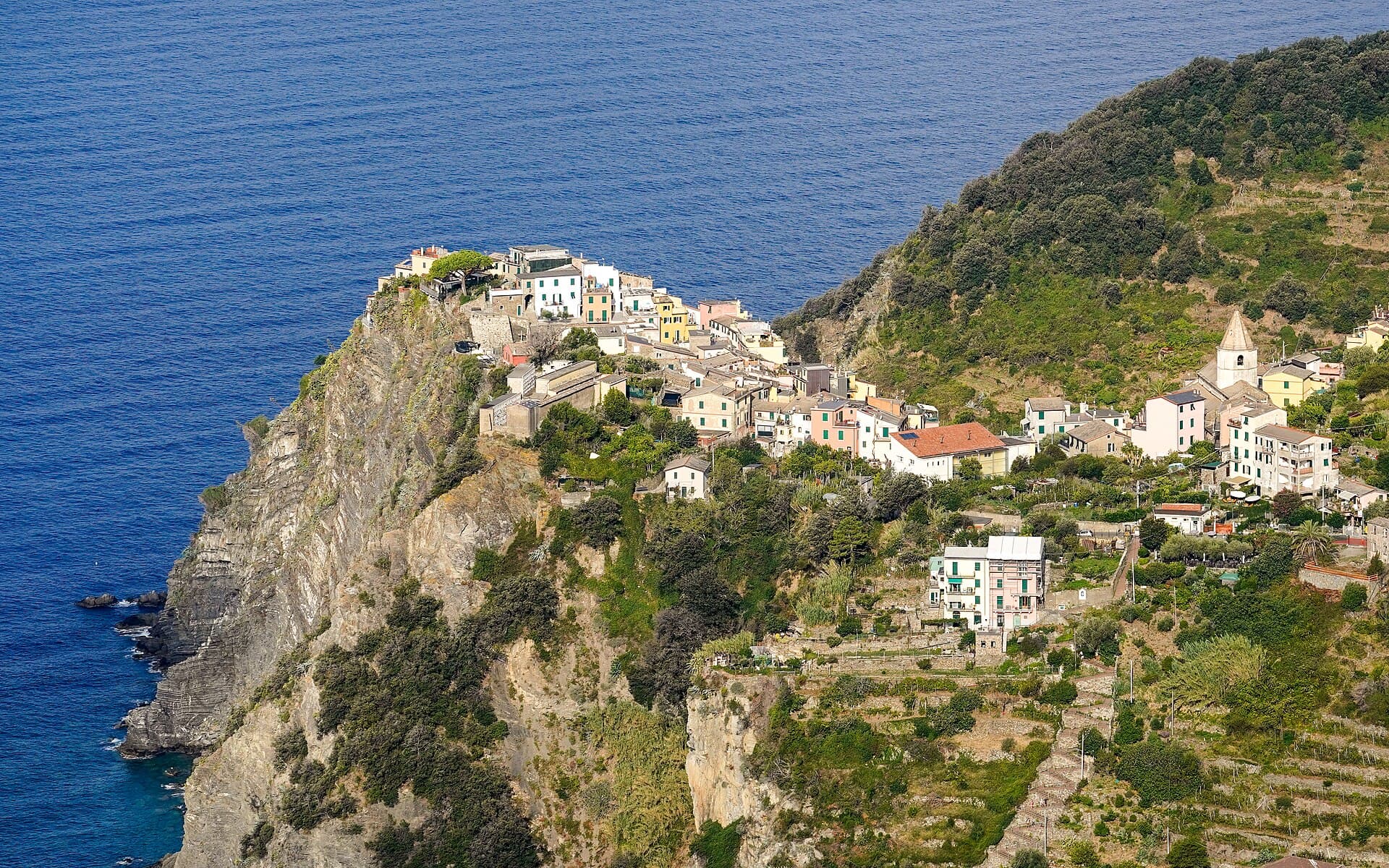
A national park on the Ligurian coast holding five villages hung on cliffs above the sea — Monterosso, Vernazza, Corniglia, Manarola and Riomaggiore — and on the World Heritage list. The terraces are the essence of the site: over a thousand years the inhabitants built thousands of kilometres of dry stone walls to hold soil on very steep slopes and grow vines and olives. The total length of these walls is estimated at about six thousand seven hundred kilometres — longer than the Great Wall of China. That is the reason for the World Heritage listing: not the coloured villages alone but the agricultural landscape people made by hand in a place unfit for agriculture. The system is threatened today: the young have left farming, neglected walls collapse, and landslides have increased — the worst in 2011 destroyed parts of Vernazza and Monterosso. The paths are ticketed and a train links the villages.
The total dry stone walling built by farmers by hand.
The listing is for the terraced land, not the coloured villages alone.
Abandoned farming means collapsing walls and more landslides.
The Ligurian coast between Levanto and La Spezia
Three ways. The local train is fastest and most used: it links the villages in minutes through tunnels beneath the cliffs. Boats in season give the best view of the villages from the sea but do not stop at Corniglia. And walking the paths is the real experience but requires fitness and proper footwear — the trails climb and descend steeply and are not the level coastal stroll many people expect.
April and May, or late September and October. Crowding in July and August is severe enough that the authorities have repeatedly discussed capping visitor numbers — the villages are very small and their lanes are overwhelmed by thousands arriving daily by train and cruise ship. If you come in season, stay overnight in one of the villages: early morning and the evening after the day trips leave are when the Cinque Terre can be seen as they really are.