The whale gallery
Some thirty skeletons along a portico over a hundred metres long, ending with a complete 22-metre blue whale.
Federigo Federighi — CC BY-SA 4.0 · Stefano Puzzuoli — CC BY-SA 4.0 · Mattia Nocciola — CC BY-SA 4.0 · Mattia Nocciola — CC BY-SA 4.0
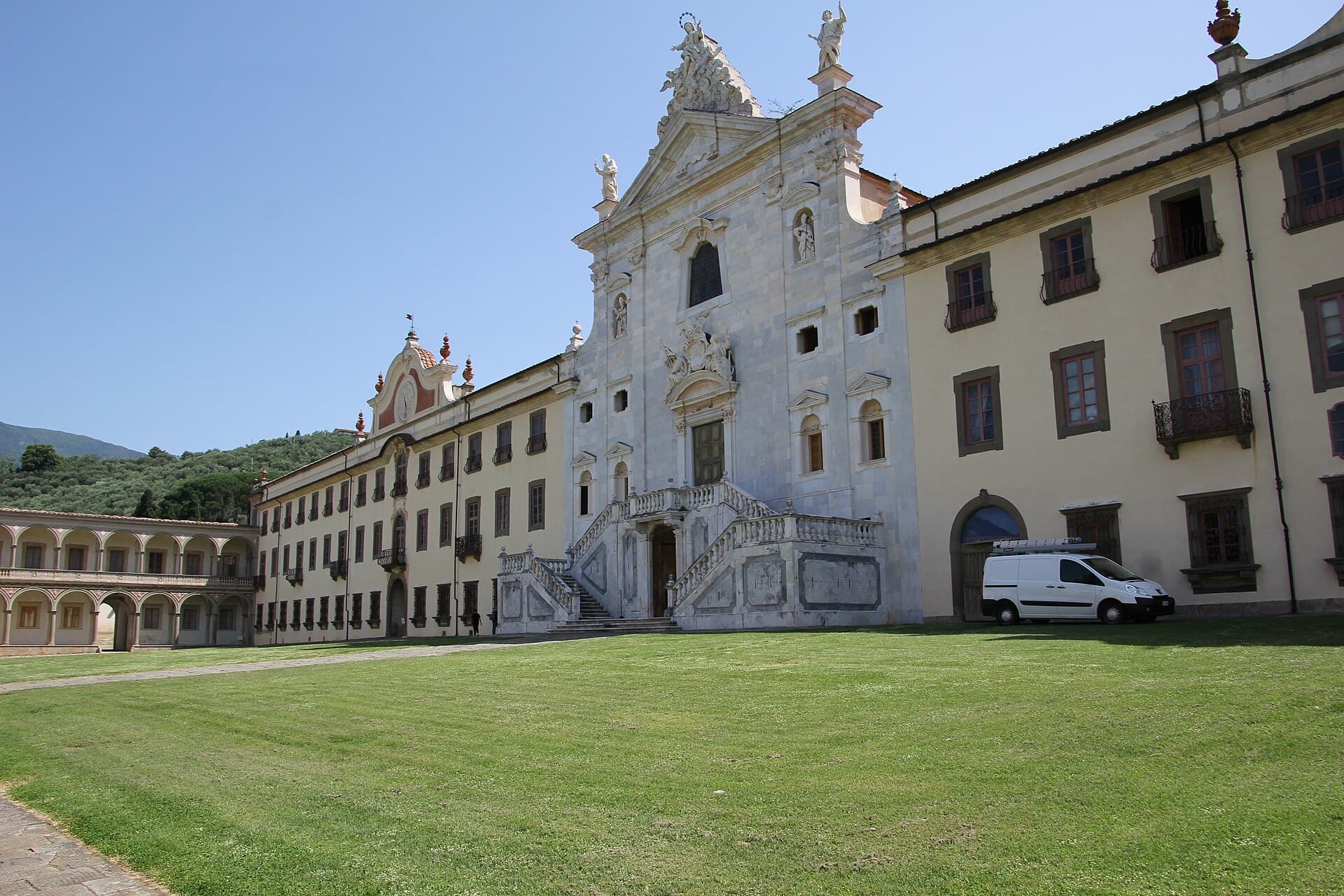
In a stone portico more than a hundred metres long, looking out over olive terraces climbing the hillside, some thirty whale and dolphin skeletons hang overhead and run the length of the floor — the last and largest a complete blue whale of 22 metres, the biggest animal that has ever lived. Walking beneath it quietly rearranges your sense of scale. Nothing in Pisa itself, tower and cathedral included, gives you that particular moment. The museum is also far older than its modern galleries suggest. It dates its own founding to 1591, when Grand Duke Ferdinando I de' Medici founded a gallery of natural curiosities attached to Pisa's botanical garden, making this one of the oldest continuously kept natural history collections in Europe. Since the 1980s it has occupied a large wing of the Certosa di Calci. The whale gallery is not all of it: there is a dinosaur hall, Italy's largest freshwater aquarium at thirty-nine tanks, and a room on human evolution with life-size hominid reconstructions, all on the same ticket. The mineral gallery and the amphibian and reptile gallery are closed for refurbishment with no announced reopening date, so check the site before travelling if either is your reason for coming. One thing confuses visitors daily: one building, two tickets. The historic charterhouse next door — its church, its monks' cells, its frescoed corridors — is a state-run national monument visited by timed guided tour that must be booked ahead by phone, closed on Mondays, with its own separate ticket of about €5 that includes nothing of the museum, and vice versa. The rule is simple. With children, go to the museum without hesitating; it can absorb three full hours. If you love monastic architecture and quiet, add the charterhouse — but it will not entertain a nine-year-old. The journey is part of the decision. Bus 120 leaves from Sesta Porta beside Pisa Centrale station and reaches Calci in about half an hour, followed by a walk of roughly ten minutes to the entrance. Services thin out in the evening and on Sundays, so photograph the return timetable before you board rather than discovering it after dark in a small town. Driving takes twenty to thirty minutes, and the small car park by the entrance fills up at weekends. One more thing: the building is historic and not fully air-conditioned, so the upper galleries get punishing at the height of summer. And honestly: if you have only one day in Pisa, the Piazza dei Miracoli wins, no argument. If you have a second day, or children who have had enough of churches, this is the best value in the province.
Some thirty skeletons along a portico over a hundred metres long, ending with a complete 22-metre blue whale.
The museum and the historic charterhouse share walls but not tickets or hours; the charterhouse closes on Mondays and needs booking.
Dinosaurs, Italy's largest freshwater aquarium and room to move, after two days of churches and queues.
Via Roma 79, Calci — inside the Certosa complex, 12 km east of Pisa
If Pisa is a single day for you, no — the Piazza dei Miracoli deserves that time. With a second day, or with children, clearly yes: travel plus visit runs to about four hours, and you leave with a sight nothing else in Tuscany repeats.
Yes, and it is a sensible pairing if both interest you. Start with the charterhouse, since it runs on fixed guided-tour times that must be booked ahead and closes Mondays, then move to the museum, which stays open all day. If you land on a Monday, the museum alone is open — and it is plenty.