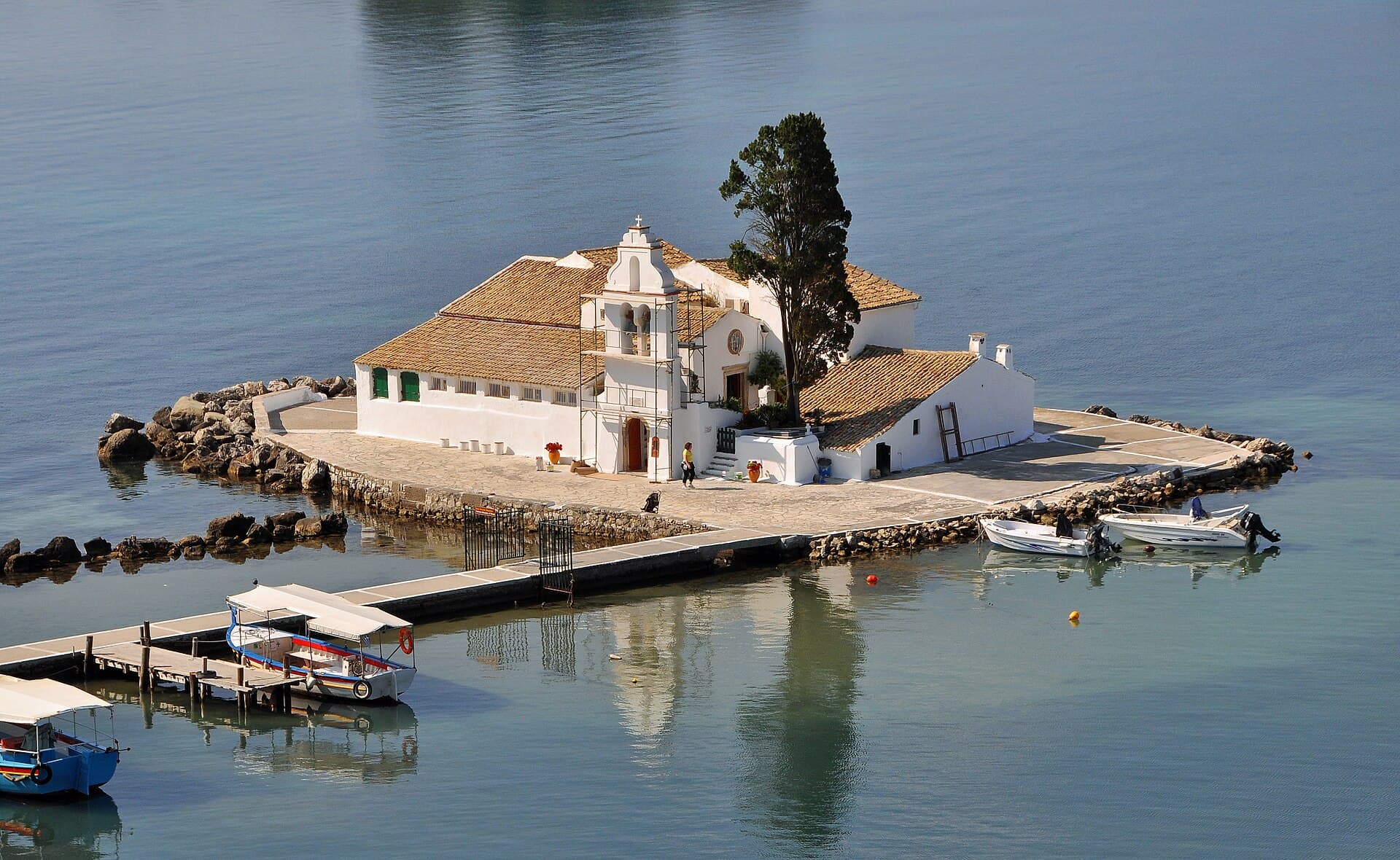
The Kanoni viewpoint
The island and Vlacherna in one scene on still water.
Dimitris Pachakis — CC BY-SA 2.0 · Marc Ryckaert — CC BY 3.0 · Catsimpoolas, Nicholas — Public domain · Catsimpoolas, Nicholas — Public domain
**Mouse Island** — a very small island covered in cypresses, with a little white Byzantine chapel rising out of them, in still water off Kanoni. The name comes from *pontiki*, "mouse" — said to derive from the white stairway up to the chapel, which from a distance looks like a mouse's tail. But its best-known story is mythical: the **Odyssey** has the Phaeacians — the people of this island in the epic — carry **Odysseus** home in their ship, at which **Poseidon**, angered, turned the returning vessel to **stone**. Local tradition points at Pontikonisi as that petrified ship. ⚠ And the practical reality: **most people never set foot on it** — it is essentially **a view to be looked at** from the Kanoni terrace, where the island sits beside Vlacherna Monastery in the single most photographed scene on the island.
The island and Vlacherna in one scene on still water.
A stairway among the cypresses that gave the island its «mouse» name.
The approach path passes right overhead — a sight many people love.
Kanoni, 49100 Corfu, Greece
**Just look — unless you collect places.** ✅ **What you see from the Kanoni terrace is the picture** that brought you here: the island, the cypresses, the chapel, Vlacherna and its narrow causeway, all in one frame — **and it is free**. ⚠ **What you find if you cross**: an island you cross in **five minutes**, a chapel **usually locked**, a short stair, and no explanation or facilities — while losing the angle that makes the place beautiful in the first place, because you are now **inside** the picture rather than in front of it. ✅ **When is crossing worth it?** If you have children who enjoy the boat ride itself, if you want to swim off the nearby water, or if you like standing in a place you have read about. ⚠ And note: the boat is **seasonal and stops in wind** — check on the day.
**Corfu is the traditional candidate for Scheria, the island of the Phaeacians in the epic.** In the **Odyssey**, Odysseus is washed up wrecked after a storm on the shore of an island ruled by King Alcinous; the princess **Nausicaa** finds him on the beach and takes him to her father's palace, where he is honoured and tells his whole story — one of the best-known passages in the poem. The Phaeacians then carry him home to Ithaca, and **Poseidon** punishes their ship by turning it to stone at the mouth of their harbour. ✅ **The identification with Corfu is old** and traditionally accepted since classical times, ⚠ but it is **not an established archaeological fact** — Homer's geography is poetic, and other islands have competing claims. ✅ **As a visitor**: take it for what it is — a fine literary layer over the place, which lets a small rock in the water carry three thousand years of story.