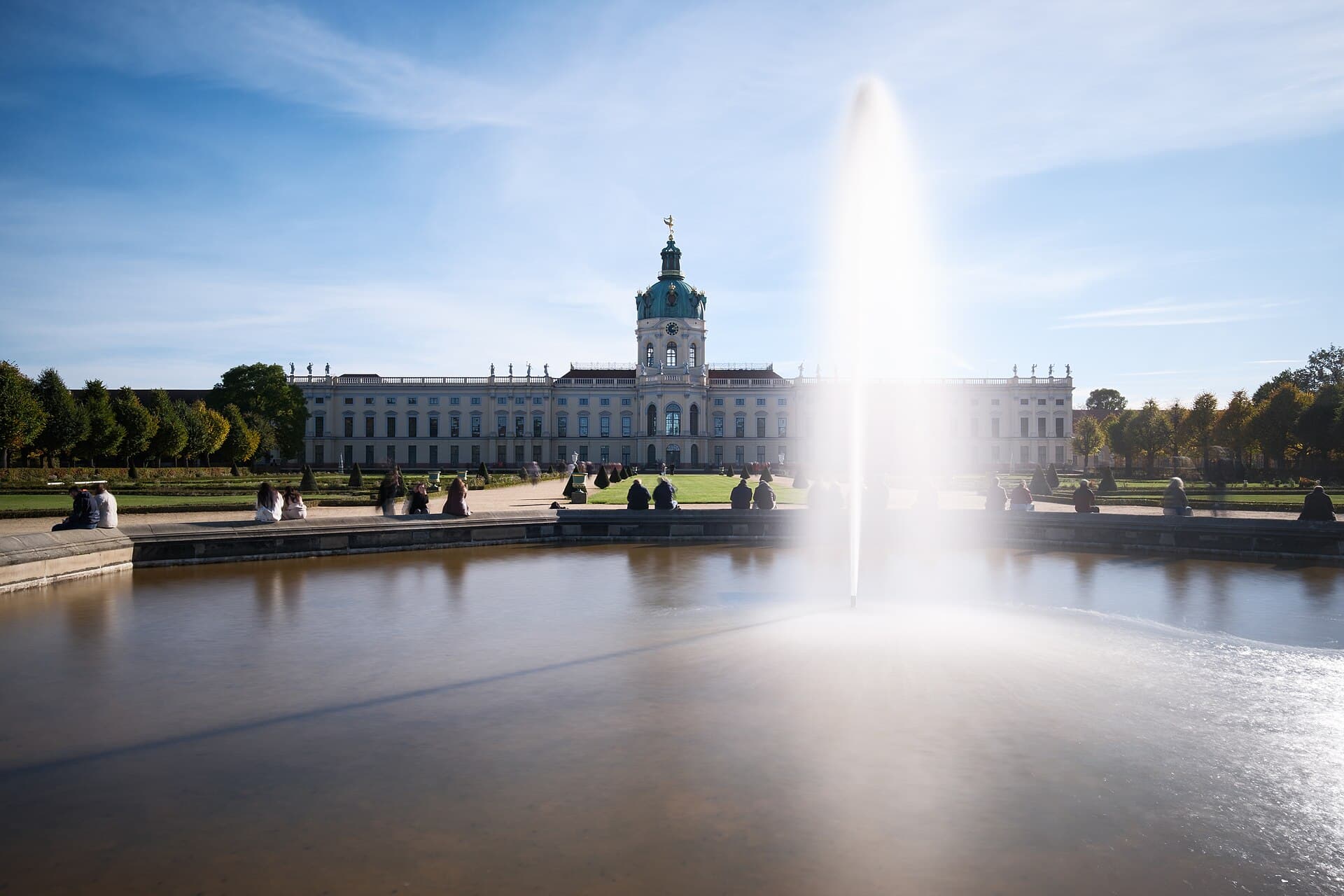
The baroque parterres
Strict French symmetry before the palace.
Gunnar Klack — CC BY-SA 4.0 · Dguendel — CC BY 4.0 · Dguendel — CC BY 4.0 · Benoît Vicart — CC BY 4.0
The gardens of Charlottenburg Palace run behind the largest surviving palace in Berlin, and they are among the oldest baroque gardens in Germany: laid out in 1697 in the French manner by a pupil of Le Notre's school, who designed the gardens at Versailles — symmetrical geometric parterres, clipped trees and straight walks running from the palace front toward the river. In the nineteenth century the rear section was entirely redesigned in the free English style: a winding lake, unconstrained trees and irregular lawns. So the garden today shows both schools side by side — you step out of strict symmetry into studied disorder, a transition visible within a few paces. Two small buildings inside reward a stop: the Mausoleum, a small columned temple holding the tombs of Queen Luise and her husband in white marble, and the Belvedere, an octagonal tea house on the riverbank housing a collection of Berlin porcelain. The gardens are entirely free, unlike the palace, and they are the finest baroque space in the city.
Strict French symmetry before the palace.
A small marble temple for Queen Luise.
Spandauer Damm 20-24, 14059 Berlin
The garden is free and gives you the full architectural setting from outside, and may suffice on a tight schedule. But the palace holds one thing with no substitute: the Porcelain Cabinet, lined floor to ceiling with thousands of pieces of Chinese porcelain, and the rococo Golden Gallery. If you do go in, choose the old wing rather than the new.