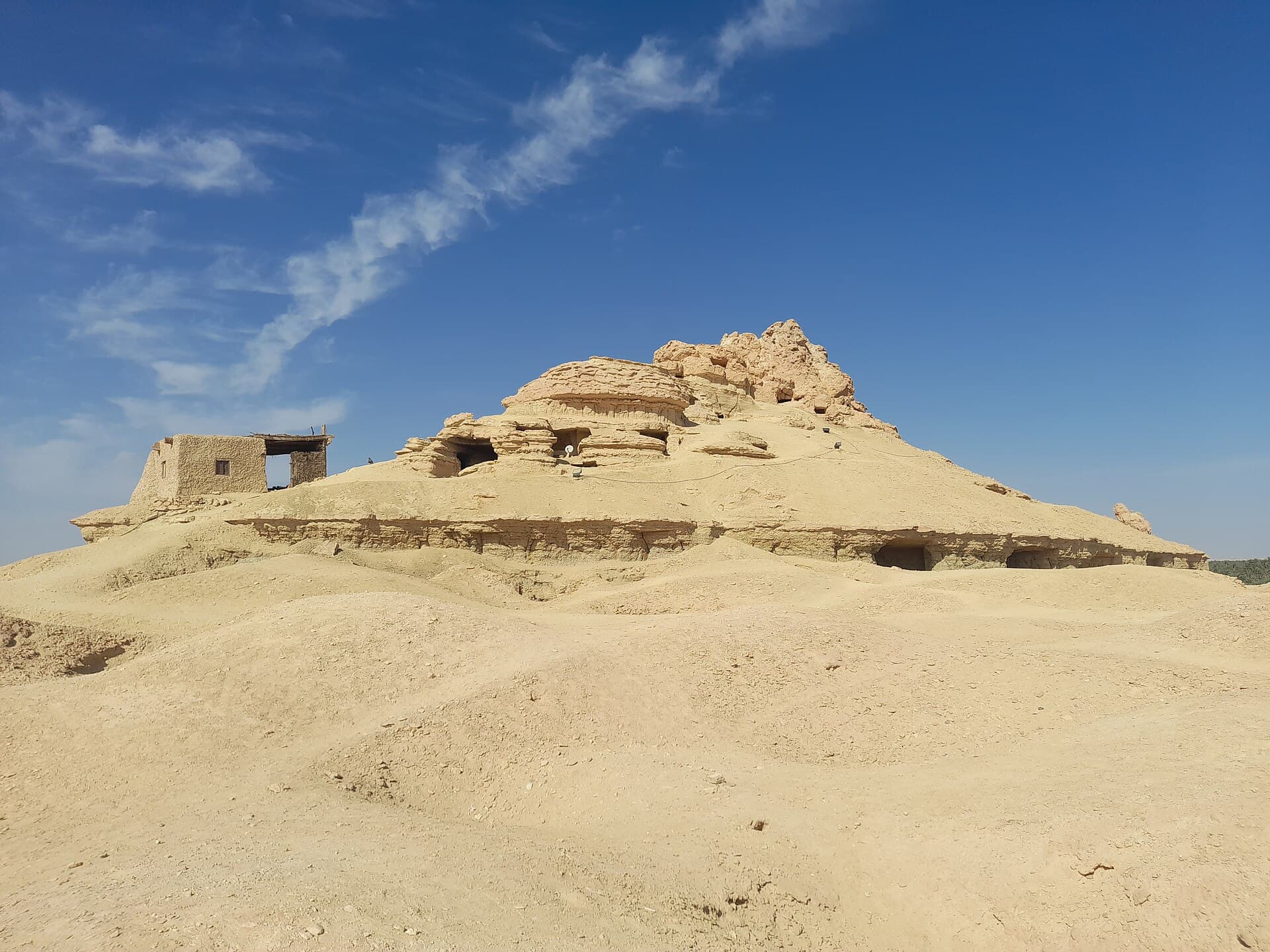
Shali sunset
Golden mud over the oasis.
ولاء — Public domain · أحمد ناجي — CC BY-SA 4.0 · Vojife — CC BY 3.0 · Nada_Mahrous — CC BY-SA 4.0 · Mohamed shokry algarnosy — CC BY-SA 4.0 · Mohamed shokry algarnosy — CC BY-SA 4.0 · ولاء — Public domain · Amr F.Nagy — Public domain
The old fortified town at the heart of Siwa Oasis, built by its people in the twelfth century on a rocky hill to shield them from desert raids; Shali means town in the Siwi language. It stayed inhabited for centuries, its houses packed together and climbing the hill like a beehive. Shali was built of kershef, a mix of mud and lumps of rock salt from the oasis lakes that keeps houses cool in the heat. But it melts in rain, and when heavy rain fell for three days in 1926 many buildings collapsed; the people gradually moved to new houses at its foot, leaving ruins in strange, almost sculpted shapes. Parts have been restored with European Union funding using traditional materials and methods, and the old mosque with its mud minaret still stands. You climb its narrow lanes to the top for views over Siwa town, the palm groves, the salt lakes and the Mountain of the Dead. The ministry list shows no ticket for it, and walking around is usually free. The best time is sunset, when the mud turns gold, after which the fortress is lit at night, with the market and cafés below.
Golden mud over the oasis.
An ancient mud minaret.
Palms, lakes, hills.
Centre of Siwa town, Siwa Oasis, Matrouh
They are built of kershef, mud mixed with salt, which dissolves in rain; the rains of 1926 brought many down, leaving their strange shapes.