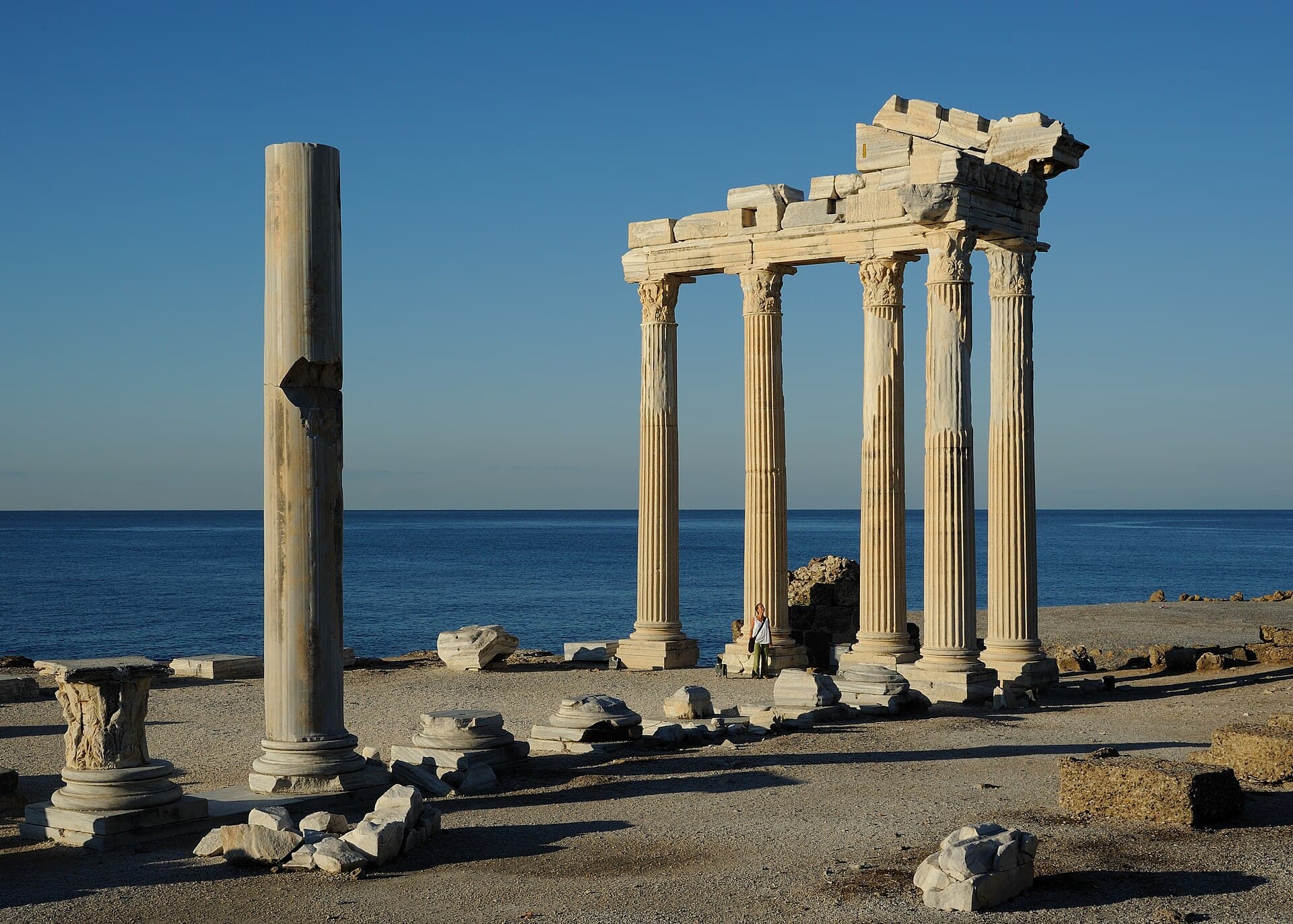
Temple of Apollo at the harbour
Five Corinthian columns at the water's edge, free, floodlit at night and at their best at sunset.
Maksym Kozlenko — CC BY-SA 4.0 · Maksym Kozlenko — CC BY-SA 4.0 · Maksym Kozlenko — CC BY-SA 4.0 · Maksym Kozlenko — CC BY-SA 4.0
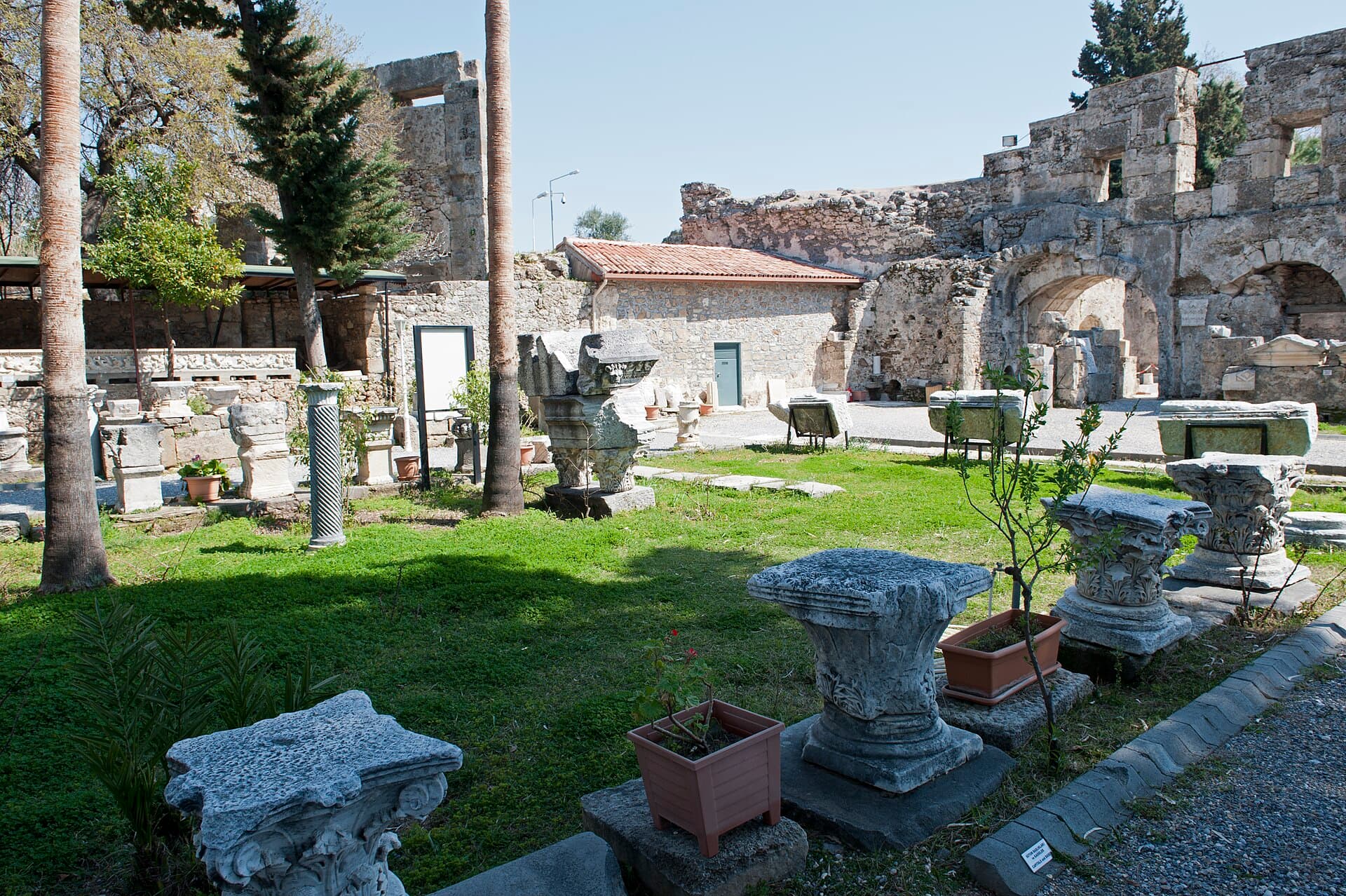
Side is not a town with ruins in it; it is a ruin that people moved back into. When Muslim refugees from Crete settled the peninsula in 1895 they built between the Roman columns, and nobody has undone the arrangement since: restaurants back onto the agora, pensions lean against Byzantine walls, and the colonnaded marble street runs from the Hellenistic city gate straight down to the harbour, where five re-erected columns of the Temple of Apollo stand at the water's edge in one of the most photographed views on this coast. The layers go deep. A Greek colony of the 7th century BC, it surrendered to Alexander without a fight in 333 BC, served in the 1st century BC as a pirate base and slave market, and peaked under Rome at perhaps 60,000 people before earthquakes and raids emptied it by the 10th century. What survives above ground is generous: the city gate and the monumental nymphaeum fountain facing it, the commercial agora, a 6th-century Byzantine hospital restored and recently opened to visitors, and the agora baths that house the Side Museum and its Roman statuary. The catch: the Roman theatre, the city's biggest monument, seating some 15,000 and rare in Anatolia for being raised on vaults rather than a hillside, has been closed for restoration since 29 November 2024 with no reopening date announced at the time of writing; you see its bulk from the street and nothing more. The archaeological-site ticket (EUR 7 for foreigners) covers the fenced precinct around it; the museum is ticketed separately at EUR 5, and the streets, harbour and temples are free at any hour. For families, the walk from the car park at the gate to the harbour is about 1.5 km on level ground, fine for pushchairs, and a small tourist train shortens it. In July and August the marble street has no shade, so go before nine or after five, when the columns are floodlit and night opening runs to about 21:30. A full loop with the museum takes two to three hours; step out of the ruins and you are in a loud package-resort town whose beaches and restaurants fill the rest of the day.
Five Corinthian columns at the water's edge, free, floodlit at night and at their best at sunset.
From the Hellenistic gate and nymphaeum down to the harbour, shops and ruins side by side, shadeless in summer.
Roman statues and sarcophagi inside the ancient bath itself, a full hour well worth the EUR 5 ticket.
Liman Caddesi No:1, Side Mahallesi, Manavgat, Antalya
Honestly, mostly no: the best of Side (the marble street, agora, harbour and Temple of Apollo) is free and unfenced. Buy the EUR 5 museum ticket on its own and save the site ticket until the theatre reopens.
For a theatre, Aspendos: its near-intact one is open and about 40 minutes' drive away, while Side's is shut. Side wins on atmosphere, with ruins, sea and restaurants in one place, and the two combine easily into a single day.
Sign in to write your review of this place.
No reviews yet — be the first.