The five columns at sunset
The sun drops into the sea behind Apollo's Corinthian columns and Side's most famous image happens in front of you.
Saffron Blaze — CC BY-SA 3.0 · Prodronemovie — CC BY-SA 4.0 · Mehmety11maz — CC BY-SA 4.0 · Maksym Kozlenko — CC BY-SA 4.0
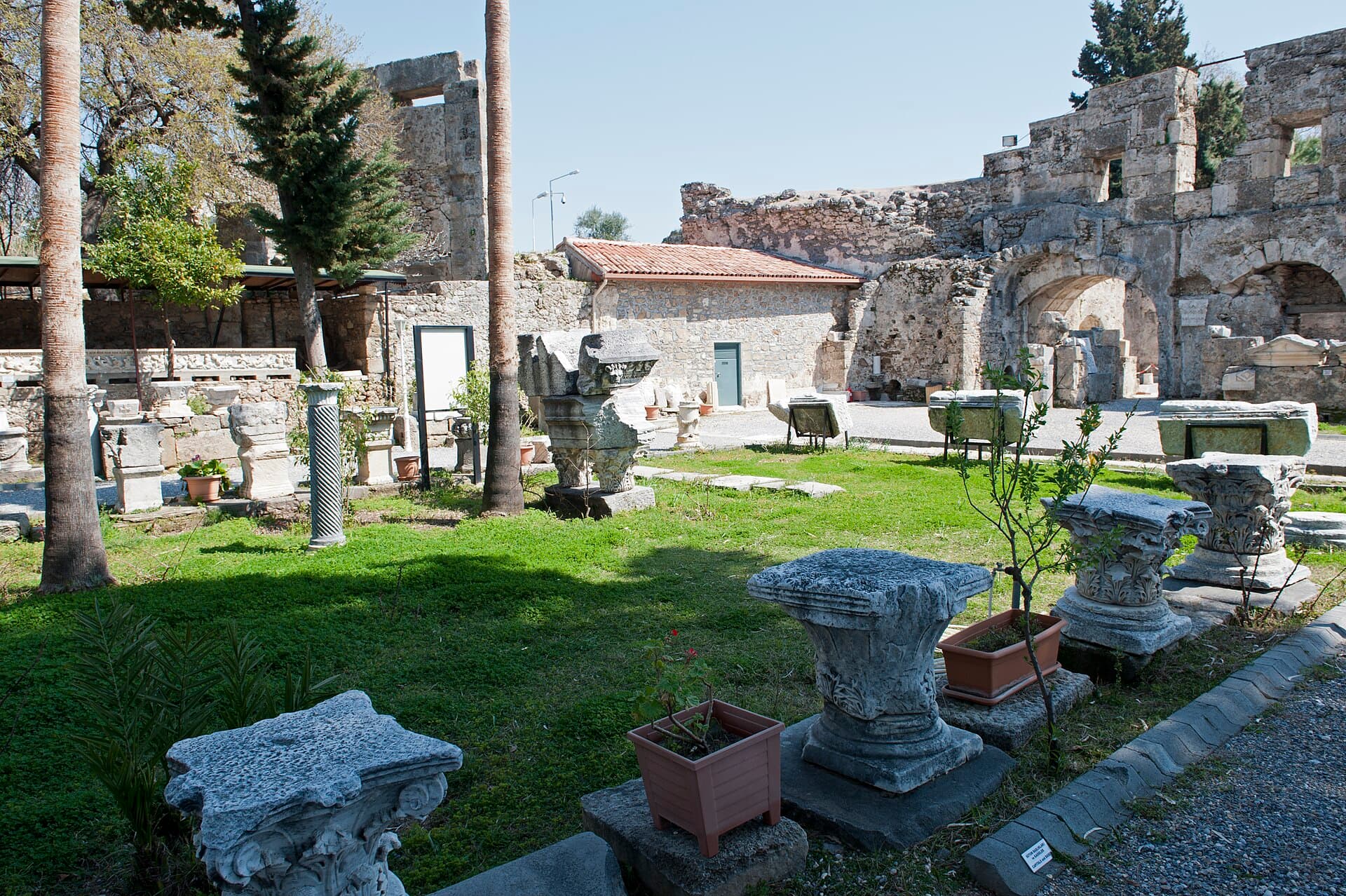
Five white marble columns and a fragment of carved entablature, standing at the very tip of the Side peninsula with nothing behind them but sea. That is all that is left above ground of the Temple of Apollo, and yet those five columns have become the picture of Side itself: on every brochure cover, in every Instagram feed, and at sunset ringed by several hundred raised phones. The temple went up around AD 150 under Antoninus Pius, Corinthian in style with leafy capitals, and in its frieze you can still pick out the Medusa heads that were meant to scare evil away from the sanctuary. The columns you see today have not stood for two thousand years, though: they were re-erected between 1984 and 1990 and patched again in 2017 after the old concrete began to fail. Right beside it sits the Temple of Athena, the larger and more important of the pair, since Athena was the city's chief deity. For decades it was little more than a stone platform and column drums lying in the grass, with a single column standing. Then, between 2023 and 2024, a major restoration re-erected around twenty columns and part of its front corner; the work finished in November 2024 and the temple was opened to visitors. The upshot is that the scene is fuller than in photos from a few years ago: two temples side by side over the harbour, and behind them the remains of a fifth-century Byzantine basilica built over the pagan precinct once the city changed religion. The honest part: this is a small site. There is no gate, no ticket and no opening hours, it is a few minutes on foot from the harbour restaurants and the lanes of the old town, and unless you are a serious photographer you will be done in a quarter of an hour. The ground is flat and mostly paved, so a pushchair is fine and small children can come, though they tire of stones quickly. What the place really rewards is timing. Arrive half an hour before sunset in spring or autumn and you will understand the crowds. In August the sunset crush is intense and the heat lingers into the evening, so go early in the morning, when you have the columns to yourself, or after dinner when they are floodlit. One last note. In May 2022 a nightclub opened on private land immediately next to the temples and used ancient remains as its entrance; the outcry was loud, the museum authority closed that doorway within days, and a criminal complaint was filed against the operator. Even so, the harbour end of the old town stays loud with bars and clubs after midnight in summer, so the precinct at night is not the serene place the photographs suggest. For families, sunset or morning is the visit, not the small hours.
The sun drops into the sea behind Apollo's Corinthian columns and Side's most famous image happens in front of you.
Around twenty columns re-erected in 2023-2024 make the larger temple legible for the first time in centuries.
Look up at the carved block above the columns for the faces placed there to ward evil off the sanctuary.
Liman Caddesi, tip of the Side peninsula, Manavgat, Antalya
On its own, no; it is fifteen minutes of stones. But Side as a whole earns half a day: the big Roman theatre (ticketed), the old lanes, the harbour, and the temples at sunset to finish. It is about an hour's drive from Antalya and less from Alanya.
In July and August go in the morning; sunset is packed, the heat does not break until well after dark, and children hate the crush. In spring and autumn sunset is the real show, and the flat ground suits a pushchair.
Sign in to write your review of this place.
No reviews yet — be the first.