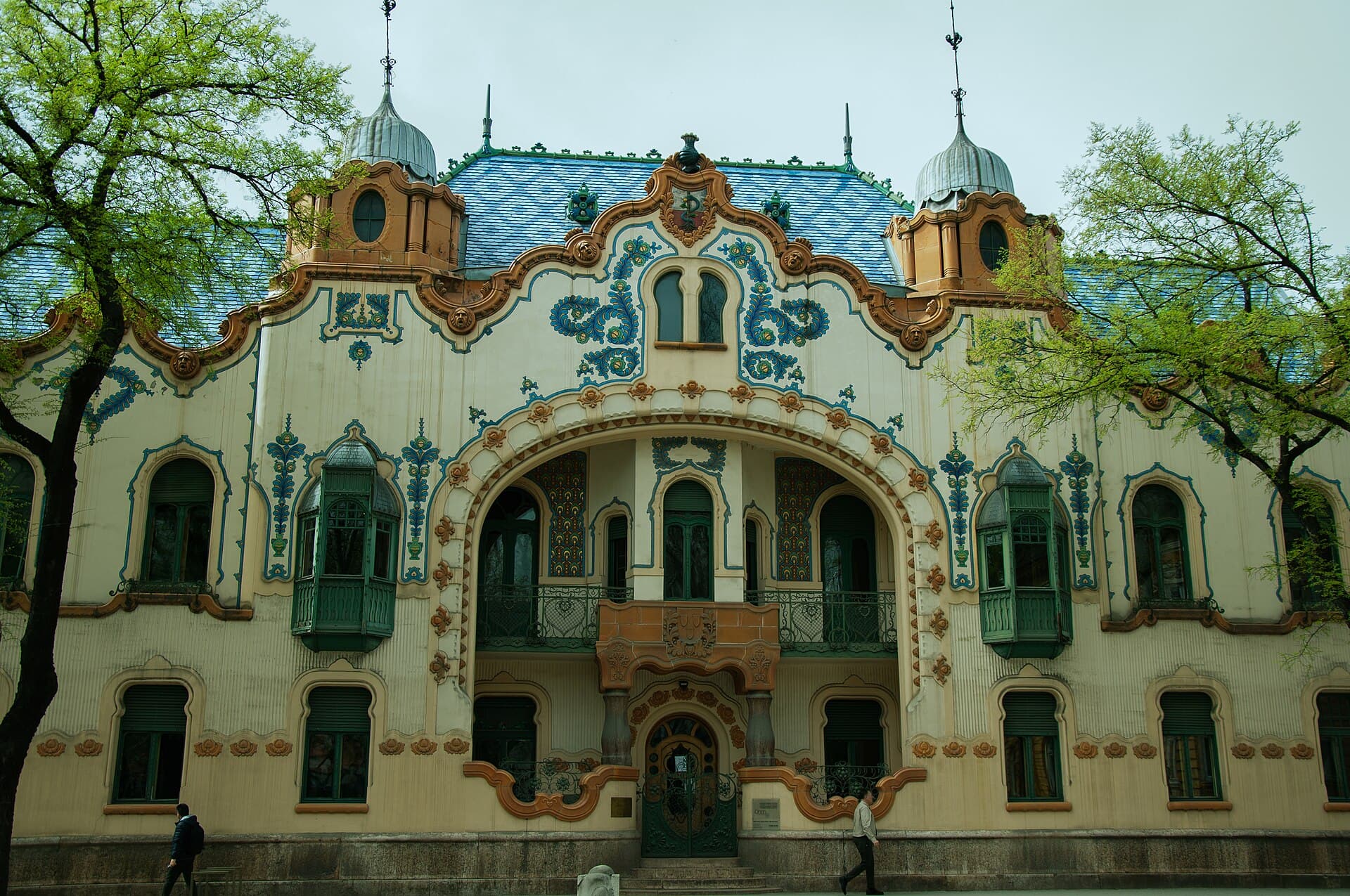
The facade
Hungarian Art Nouveau at its fullest.
Damian Pankowiec — CC BY-SA 4.0 · Mvukota — CC BY-SA 4.0 · Mickey Mystique — CC BY-SA 3.0 · Mickey Mystique — CC BY-SA 3.0 · Karolina Đukić — CC BY-SA 4.0
The Subotica Synagogue, officially the Jakab and Komor Square Synagogue, is a celebrated Hungarian Art Nouveau religious building in northern Serbia. It is the second largest synagogue building in Europe after the Dohány Street Synagogue in Budapest, and draws architecture lovers above all. It was built between 1901 and 1903 by a Jewish community of about 3,000 people, when the city was among the largest in the Kingdom of Hungary. The community hired Komor and Jakab, who later returned to design the City Hall. It was listed as a national monument in 1974 and raised to exceptional importance in 1990. A memorial at the front commemorates 4,000 Jewish citizens of Subotica killed in the Second World War. A large renovation project led to its reopening in 2018, and today it serves as a cultural venue that the small local Jewish community also uses for services. It stands out for its steel structure, modern for its day, its advanced vaulting, and ornament that blends Hungarian folk elements with Jewish motifs. It is 300 m in a straight line from City Hall, so it fits the same walk. Going inside is worthwhile if the timing works, and the exterior can be seen from the square at any time. If you enter, keep your voice down, respect the place of worship and dress modestly.
Hungarian Art Nouveau at its fullest.
Advanced for its time.
Commemorating 4,000 community members.
Jakab and Komor Square, central Subotica
Yes. It is a cultural venue that the small local Jewish community also uses for services.
We found no reliable hours or prices, so ask the Subotica tourist office.