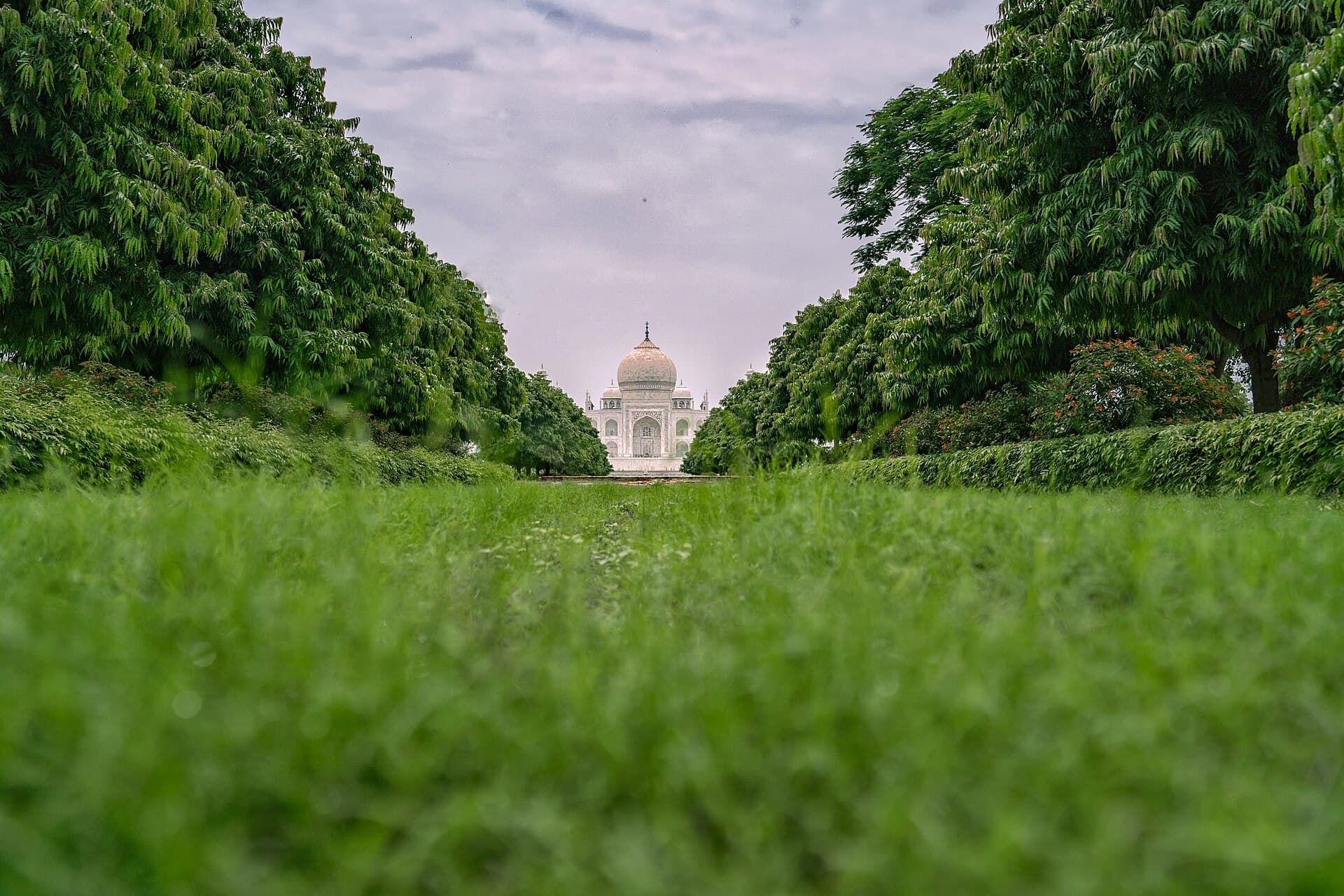
White dome
And four minarets.
Jakub Hałun — CC BY-SA 4.0 · Diego Delso — CC BY-SA 4.0 · Antrix3 — CC BY-SA 4.0 · Jakub Hałun — CC BY-SA 4.0 · Diego Delso — CC BY-SA 4.0 · MarcBW — CC BY-SA 3.0 · Yann (talk) — CC BY-SA 4.0 · Anas Kuthbudeen — CC BY-SA 3.0
India's most famous landmark and one of the most beautiful buildings in the world, an ivory-white marble mausoleum on the bank of the Yamuna in Agra, commissioned by the Mughal emperor Shah Jahan in 1631 for the tomb of his late wife, Mumtaz Mahal; he was later buried beside her. The mausoleum was finished in 1648 and the rest of the complex five years later. It is the centrepiece of a 17-hectare complex with a matching mosque and guest house on either side and formal Persian-style gardens walled on three sides, and it is a UNESCO World Heritage Site. Visitors are struck by its perfect symmetry, the great white dome and four minarets, the semi-precious stones inlaid in the marble and the Qur'anic verses in thuluth script around its gateways; the marble changes with the light, from pink at dawn to gold at sunset. Foreign visitors pay ₹1,100, per the ASI Agra circle, plus about ₹200 to enter the main mausoleum, per visitor guides. It opens from sunrise to sunset and is closed to tourists on Fridays, when its mosque is open for Friday prayers. Come at dawn to beat the crowds and the heat.
And four minarets.
In thuluth script.
And the long pool.
Right bank of the Yamuna, Agra
It is closed to tourists on Fridays, when its mosque is open for Friday prayers, and opens from sunrise to sunset on other days.
₹1,100 per the ASI Agra circle, plus about ₹200 to enter the main mausoleum, per visitor guides.