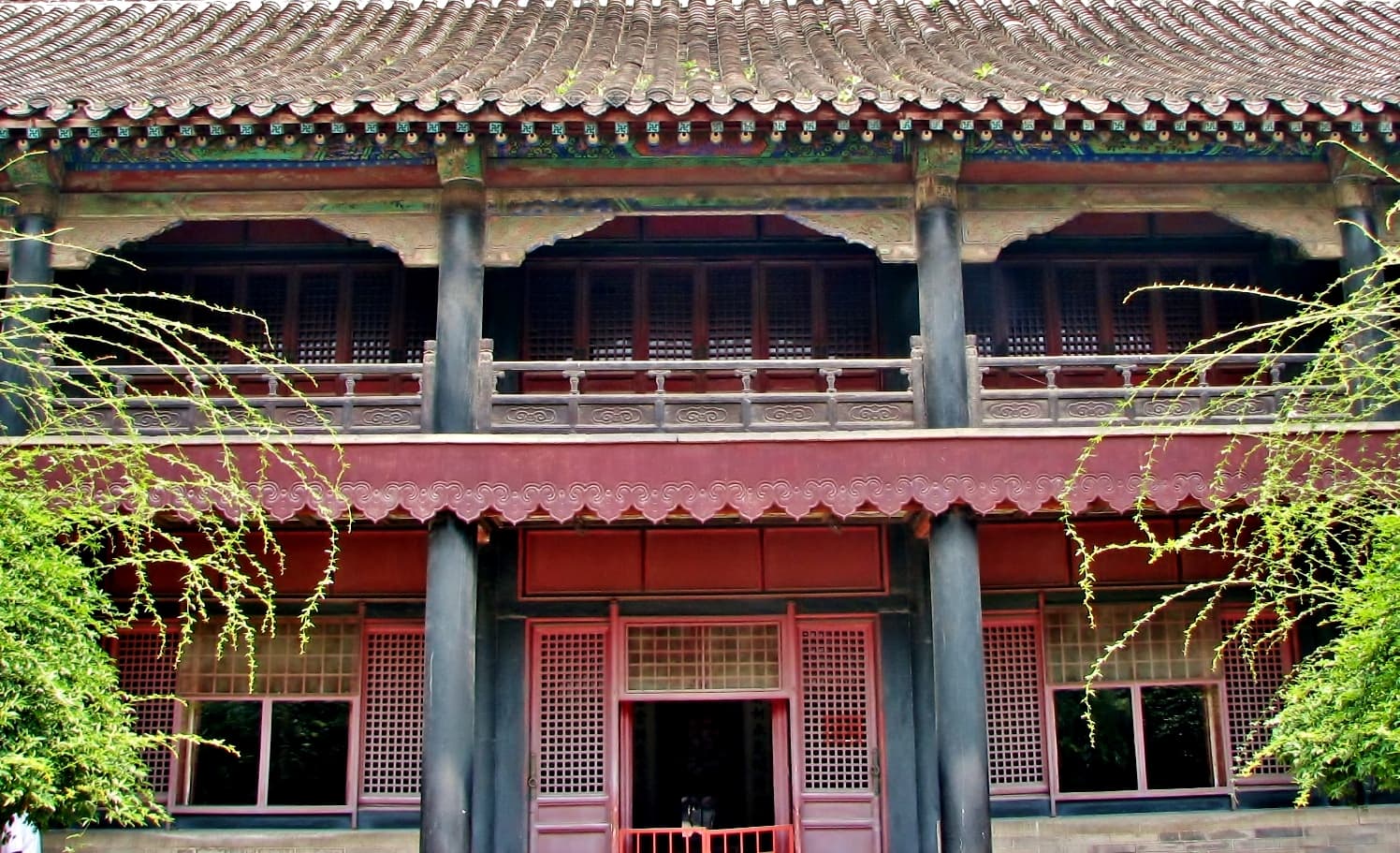
Dacheng Hall
Dragon columns.
Windmemories — CC BY-SA 4.0 · xiquinhosilva — CC BY 2.0 · xiquinhosilva — CC BY 2.0 · Diego Tirira from Quito, Ecuador — CC BY-SA 2.0 · Kyle Magnuson from Los Angeles, United States — CC BY 2.0 · xiquinhosilva — CC BY 2.0 · Diego Tirira from Quito, Ecuador — CC BY-SA 2.0 · 三猎 — CC BY-SA 4.0
The largest and best-known temple of Confucius in East Asia, raised in the home town of the Chinese philosopher and teacher who lived in the fifth century BC; a year after his death, in 478 BC, his house was turned into a place to honour him, and over the centuries it grew into a vast complex that the Chinese count, with Beijing's Forbidden City and the Summer Resort at Chengde, among the country's three greatest ancient building complexes. Emperors honoured it from early in the Han dynasty, the Song enlarged it, and it burned and was restored several times, last after a fire in 1724 that destroyed the great hall, reaching its present form with successive courtyards, gateways and ancient cypresses, among them the Double Dragon Cypress. Its chief buildings are the great Dacheng Hall with its stone columns carved with dragons, the Kuiwen Pavilion that once served as a library, and thirteen pavilions sheltering carved steles written by emperors; since 1994 it has been on UNESCO's World Heritage List together with the Kong Family Mansion and the Cemetery of Confucius. Tickets cost CNY 80, or CNY 140 for a combined ticket to all three sites, booked online in advance in the visitor's name, with last entry around 16:30, per visitor guides.
Dragon columns.
Thirteen of them.
In the courtyards.
Centre of Qufu's old town, Shandong
Yes, the CNY 140 combined ticket covers the temple, the Kong Family Mansion and the cemetery, while separate tickets cost CNY 80, 60 and 10; booking is online in advance, per visitor guides.
Yes, Qufu has a mosque near the old West Gate of the town, with Hui-run restaurants under the halal sign nearby, while pork is common in the town's other restaurants.