The internal arcades
Tiers of arches around a courtyard, from the Renaissance conversion.
Pablo Enzo — Public domain · Krzysztof Golik — CC BY-SA 4.0 · Krzysztof Golik — CC BY-SA 4.0 · Krzysztof Golik — CC BY-SA 4.0
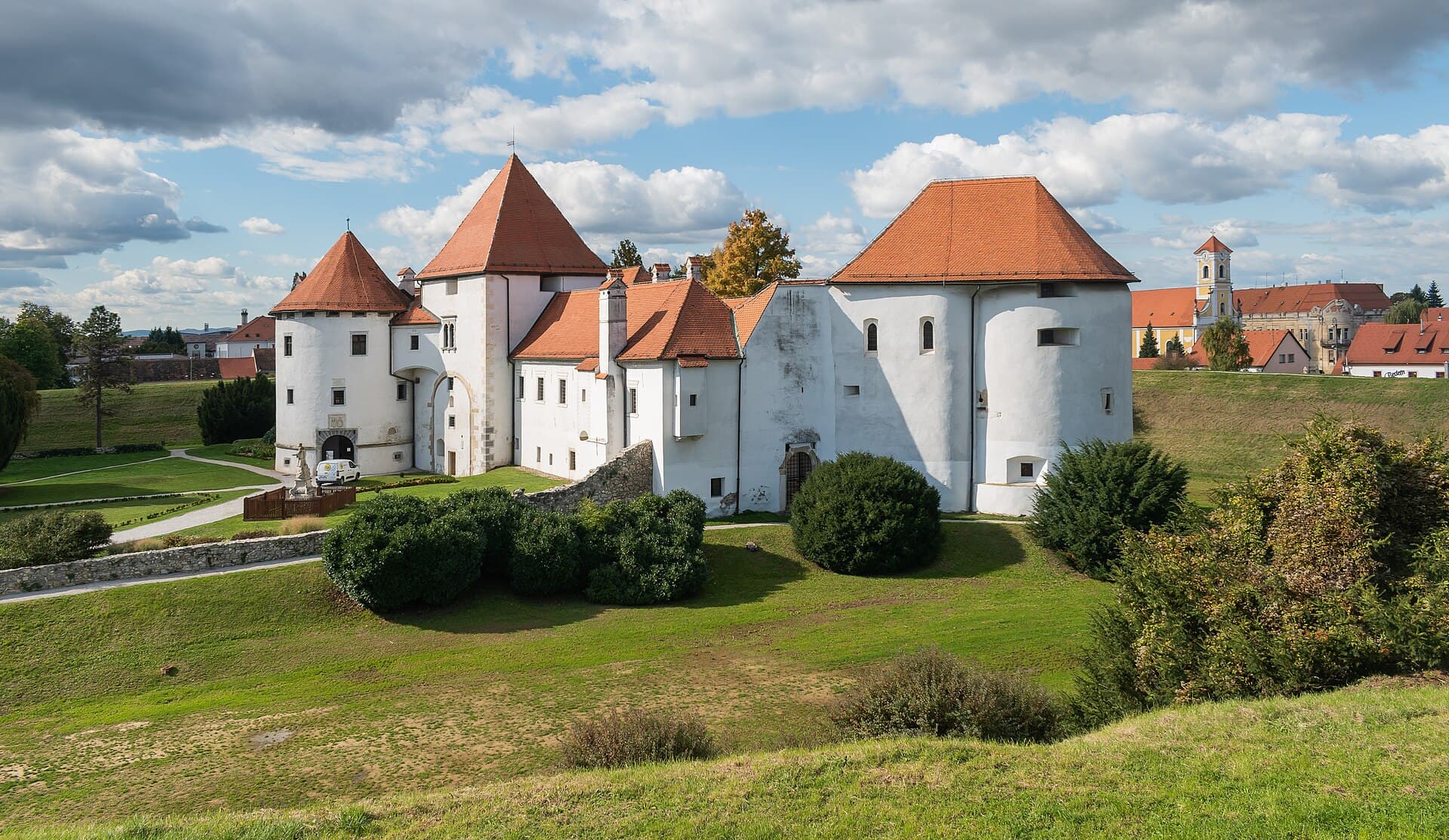
A white castle with round towers and a grassed moat, the most important building in Varaždin and its emblem. It began as a **medieval stronghold** in the fourteenth century, then was radically rebuilt in the sixteenth: redesigned on the Italian **alla moderna** pattern — low thick walls and rounded bastions covering each other with fire — because the Ottomans were advancing north and old high walls had become useless against artillery. It was never attacked, but it survived. Over the following centuries it changed from a fortress into a **noble residence** for the Erdődy family, who held it for three hundred years, adding internal arcades and furnished halls. Today it houses the **Varaždin City Museum**: furniture, arms, crafts and dress in rooms arranged by period, and one of the best historic furniture collections in Croatia. Note: **the grounds and grassed moat around it are free** and always open; the ticket is for the interior only.
Tiers of arches around a courtyard, from the Renaissance conversion.
Arranged by period, among the best in Croatia.
Around the white walls, and free to walk in.
Strossmayerovo šetalište 7, Varaždin
For two reasons, one political and one catastrophic. The political one is that it genuinely **was Croatia''s capital** between **1767 and 1776**: the Croatian royal council and the ban moved there, making it the seat of administration, so palaces were built and the nobility lived in it. The catastrophic one is that **a great fire broke out in 1776** — said to have started from a boy''s spark — and consumed most of the town. The capital moved to Zagreb and never returned. The irony is that the fire is what preserved the town''s form: it was rebuilt **all at once** in the baroque of the day, and then **stopped growing**, having lost its status — so its centre stayed stylistically unified, without the nineteenth-century additions that changed every other city. ⚠ It is therefore sometimes compared to small Austrian towns rather than to Croatian ones.