The Apostle's tomb
A plain marble slab under the site of the central dome marks where tradition places the burial of the last of the apostles.
Bernard Gagnon — CC BY-SA 3.0 · Satirdan kahraman — CC BY-SA 4.0 · Satirdan kahraman — CC BY-SA 4.0 · Satirdan kahraman — CC BY-SA 4.0
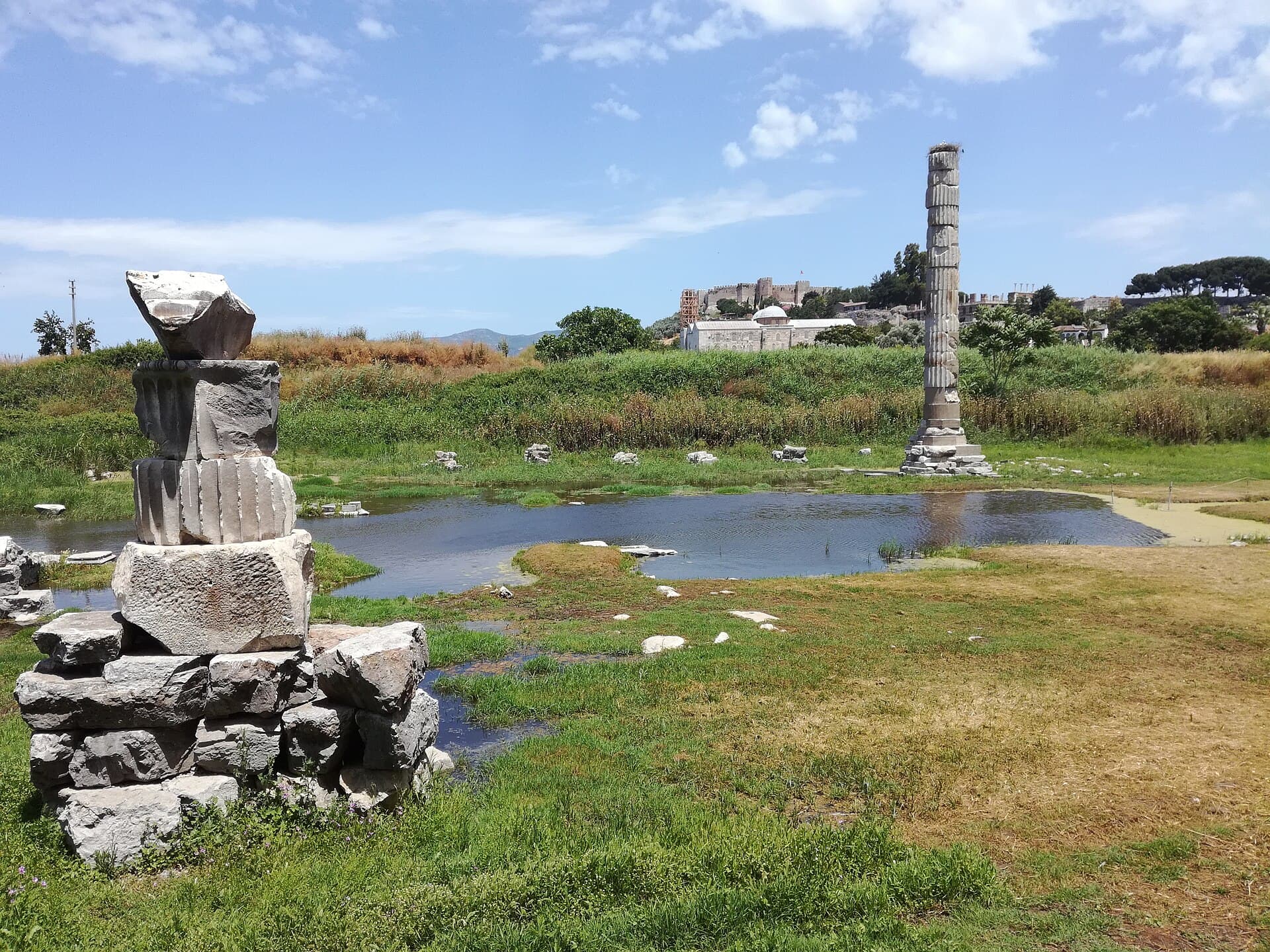
When Justinian ordered a church built over the tomb traditionally held to be that of John the Apostle in the sixth century, he did not put up a modest chapel on a hill. He built a cross-shaped colossus roughly 130 metres long under six domes, one of the largest churches of its age; had it survived intact, it would rank today among the biggest cathedrals anywhere. Even the hill's name, Ayasoluk, is a Turkish mangling of John's Greek title, Hagios Theologos, the holy theologian. What stands now is the marble skeleton of that building: re-erected columns, Byzantine brick arches, the apostle's tomb marked by a plain marble slab where the central dome once rose, an octagonal baptistery with a round font sunk into its floor, and scattered patches of mosaic. Earthquakes, raids and centuries of stone-robbing stripped the grandeur, but the cross plan is still perfectly legible, so walking it feels like reading a floor plan at full scale. The best part, honestly, is the western terrace: below you sit the Seljuk İsa Bey Mosque, the lone surviving column of the Temple of Artemis, one of the Seven Wonders, and the green plain rolling toward Ephesus. The ticket also covers Ayasuluk Fortress above the basilica, reopened after a long restoration. Be clear-eyed about it: the interior is mostly empty, a small mosque, a cistern and walkable ramparts, and the point is the view rather than the ruins. Anyone driving between Kuşadası and Ephesus stops here naturally; on its own it does not justify a whole day, but it is the link that carries the Ephesus story from Roman city to Christian shrine to Seljuk town. Getting there from Kuşadası is easy: about 20 km, roughly half an hour by car on the Selçuk road with parking at the gate, or a dolmuş that leaves the Kuşadası bus station every fifteen minutes or so for Selçuk centre, then a ten-minute uphill walk. The site is almost entirely unshaded, so in summer go early or after four in the afternoon and bring water and a hat. Ground is stony and uneven: a pushchair copes as far as the main court and gives up beyond it, and the steps to the fortress need a bit of breath.
A plain marble slab under the site of the central dome marks where tradition places the burial of the last of the apostles.
The best view in Selçuk: İsa Bey Mosque, the last column of the Temple of Artemis and the plain toward Ephesus in a single frame.
A round font sunk into the floor, with steps down on either side for full immersion, says more about sixth-century ritual than any information board.
İsa Bey Mah., St. Jean Sok. No:4, Selçuk, İzmir
Yes if you have a spare hour, since it is practically on the way and explains what became of Ephesus after Rome. If time is short or the heat is brutal, stick to Ephesus; the basilica is open, shadeless ruins and the fortress above is a view rather than a sight.
No. The mosque is free and open outside prayer times at the foot of the hill, and the Temple of Artemis is free too, a few minutes' walk away. The EUR 6 ticket covers only the basilica and the fortress; the foreigners' Museum Pass Türkiye is accepted.
Sign in to write your review of this place.
No reviews yet — be the first.