The Great Hypostyle Hall
134 columns, the central ones over twenty metres, each needing six men to encircle.
Vyacheslav Argenberg — CC BY 4.0 · Holger Uwe Schmitt — CC BY-SA 4.0 · Holger Uwe Schmitt — CC BY-SA 4.0 · Holger Uwe Schmitt — CC BY-SA 4.0
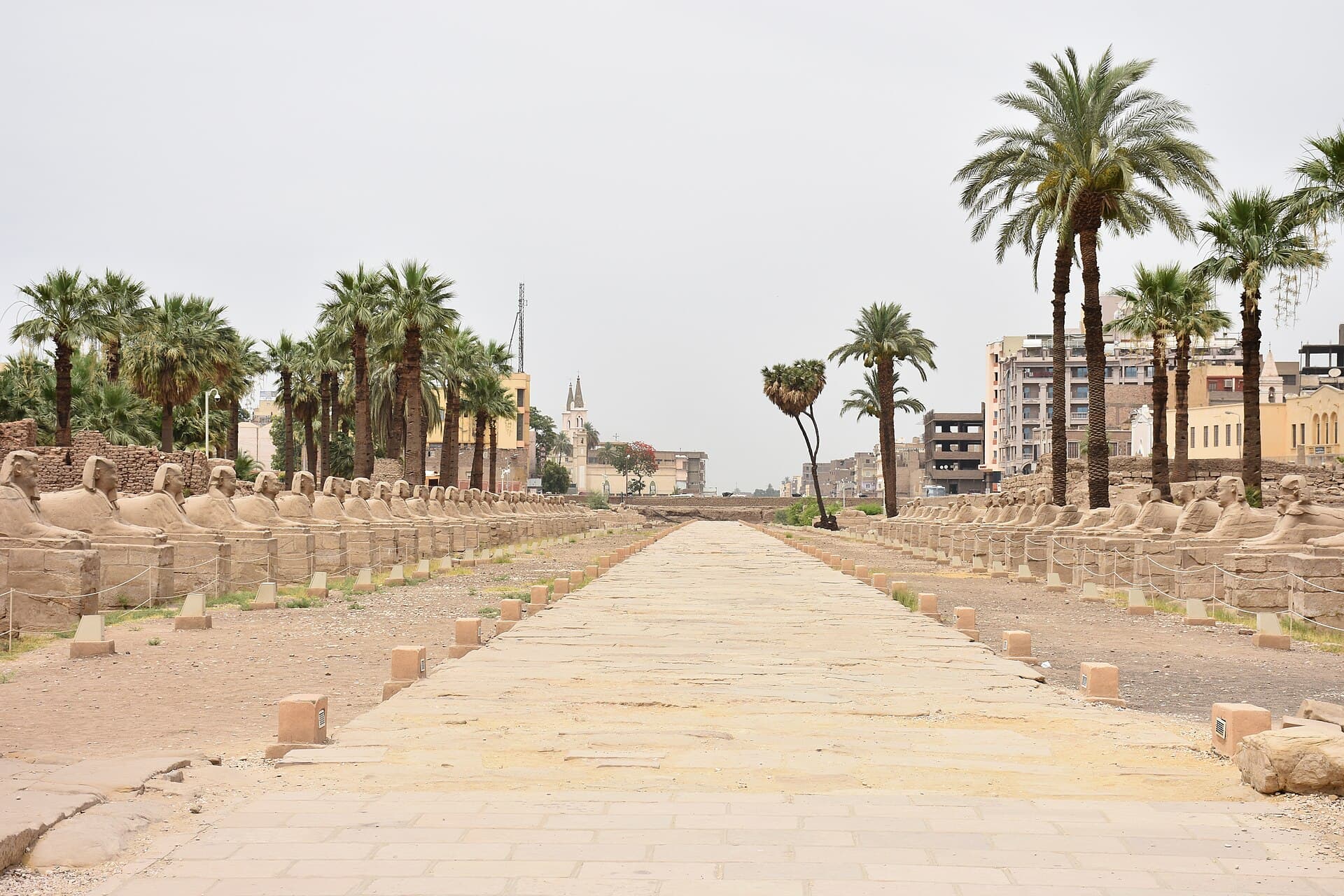
The largest religious complex ever built, and not the work of one reign but of roughly two thousand years — every pharaoh added something. That is the point that explains the place: Karnak is not one temple but dozens of temples, pylons, obelisks and lakes within a single enclosure, raised from the Middle Kingdom to the Ptolemaic period. One pharaoh builds a pylon; his successor builds a larger one in front of it; a third demolishes what his predecessor built and reuses the stone. The whole history of Egypt is written in that accumulation. The Great Hypostyle Hall is its most famous part and the greatest surviving work of Egyptian architecture: a hundred and thirty-four columns in sixteen rows, the central ones over twenty metres high and three and a half metres across — six men with linked arms are needed to encircle one. The roof was once complete and the hall was dark, lit through clerestory windows. It also holds the obelisk of Hatshepsut, the tallest still standing in Egypt, the avenue of sphinxes, the sacred lake, and the main temple of Amun-Ra. The restored and reopened Avenue of Sphinxes runs about three kilometres from Karnak to Luxor Temple and can be walked. The area is vast, the walking long with almost no shade, and two and a half hours is a realistic minimum. A sound and light show runs in the evening on a separate ticket.
134 columns, the central ones over twenty metres, each needing six men to encircle.
The tallest obelisk still standing in Egypt.
Three kilometres of statues linking Karnak to Luxor Temple, and walkable.
Karnak, north of Luxor
Right at opening, which is better by a wide margin: the coaches arrive an hour or two later, and after nine in the morning the Luxor heat in summer is brutal. The alternative is the last two hours before closing, when the sun eases and the groups have gone.
Karnak without competition — far larger and richer, and the Hypostyle Hall alone justifies the trip. Luxor Temple is smaller and takes an hour, and its advantage is being in the middle of town and visitable at night when lit. The ideal order is Karnak in the morning and Luxor Temple after dark.
It helps more here than at any other site in Egypt. Karnak is layered and confusing, the reliefs and pylons unreadable without explanation, and it is very easy to walk it for two hours without understanding what you saw. Licensed guides wait at the gate.