
The concave slope
Sitting on the tilted paving looking up at the tower.
Mark Sehnert — Public domain · Ввласенко — CC BY-SA 3.0 · Holger Uwe Schmitt — CC BY-SA 4.0 · Holger Uwe Schmitt — CC BY-SA 4.0
**A shell-shaped square sloping inward, divided into nine sectors, where a horse race is run twice every summer** — one of the great squares of Europe. ⚠ **Its shape is not decorative**: the square is **concave like a fan**, falling from its rim to a single point in front of the **Palazzo Pubblico** — **a drainage system** gathering all the square's rainwater into one channel. ✅ **The paving is divided by nine marble lines** into **nine sectors** — commemorating the **Council of Nine**, Siena's government in its golden age (1287–1355). ✅ **Around it**: the **Palazzo Pubblico** with the Torre del Mangia, the carved **Fonte Gaia**, and **14th-century palaces** with harmonised fronts. ⚠ **And twice each summer — 2 July and 16 August — it becomes the racetrack of the Palio.**
Sitting on the tilted paving looking up at the tower.
A carved marble fountain at the square's upper rim.
Fourteenth-century palaces with harmonised windows around the square.
Piazza del Campo, 53100 Siena, Italy
 Torre del Mangia**An 88-metre tower built to exactly equal the cathedral — a statement that stat1 minute walk3.8
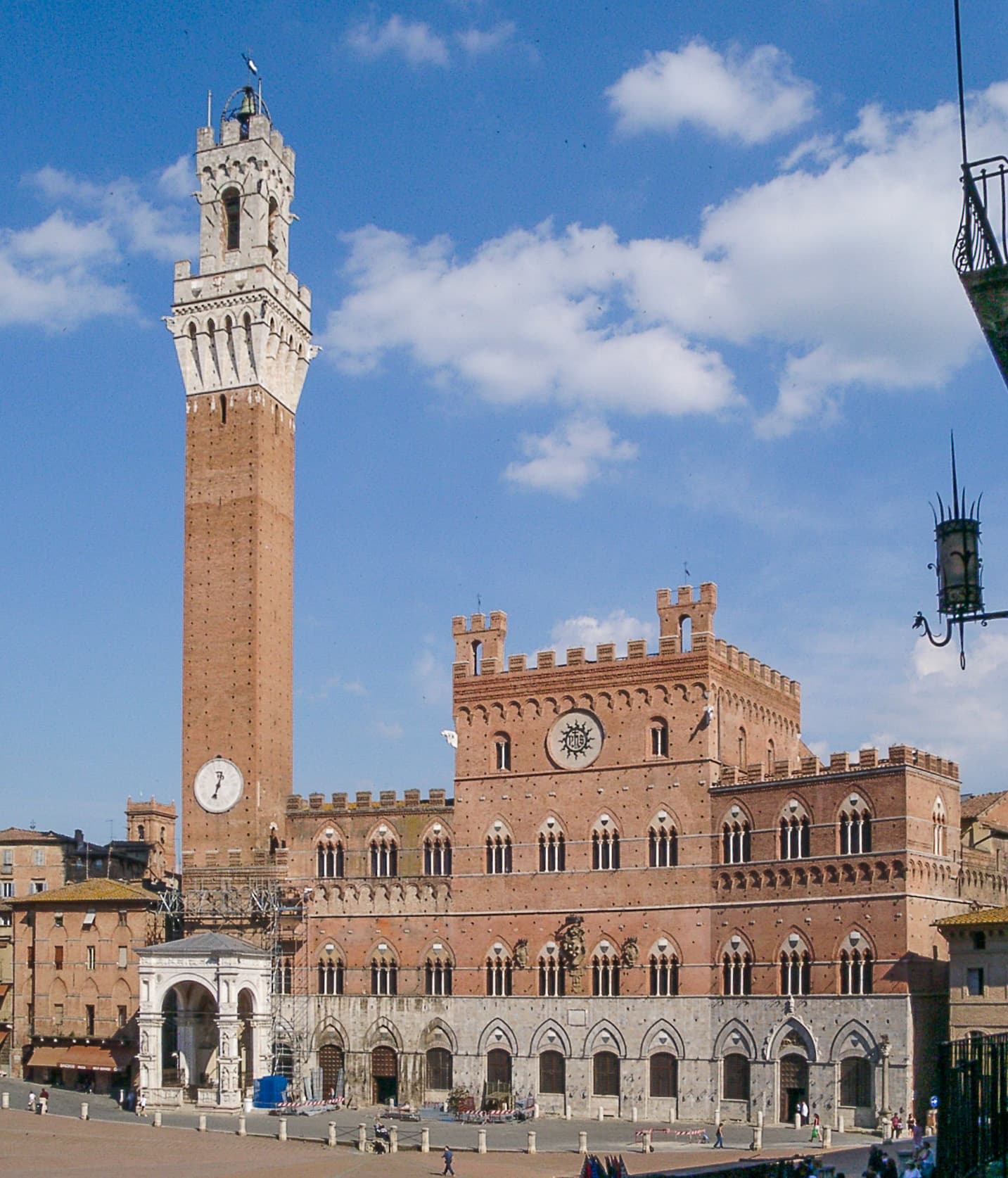 Palazzo Pubblico**A 14th-century town hall still in use, holding the most famous political paint1 minute walk4.8
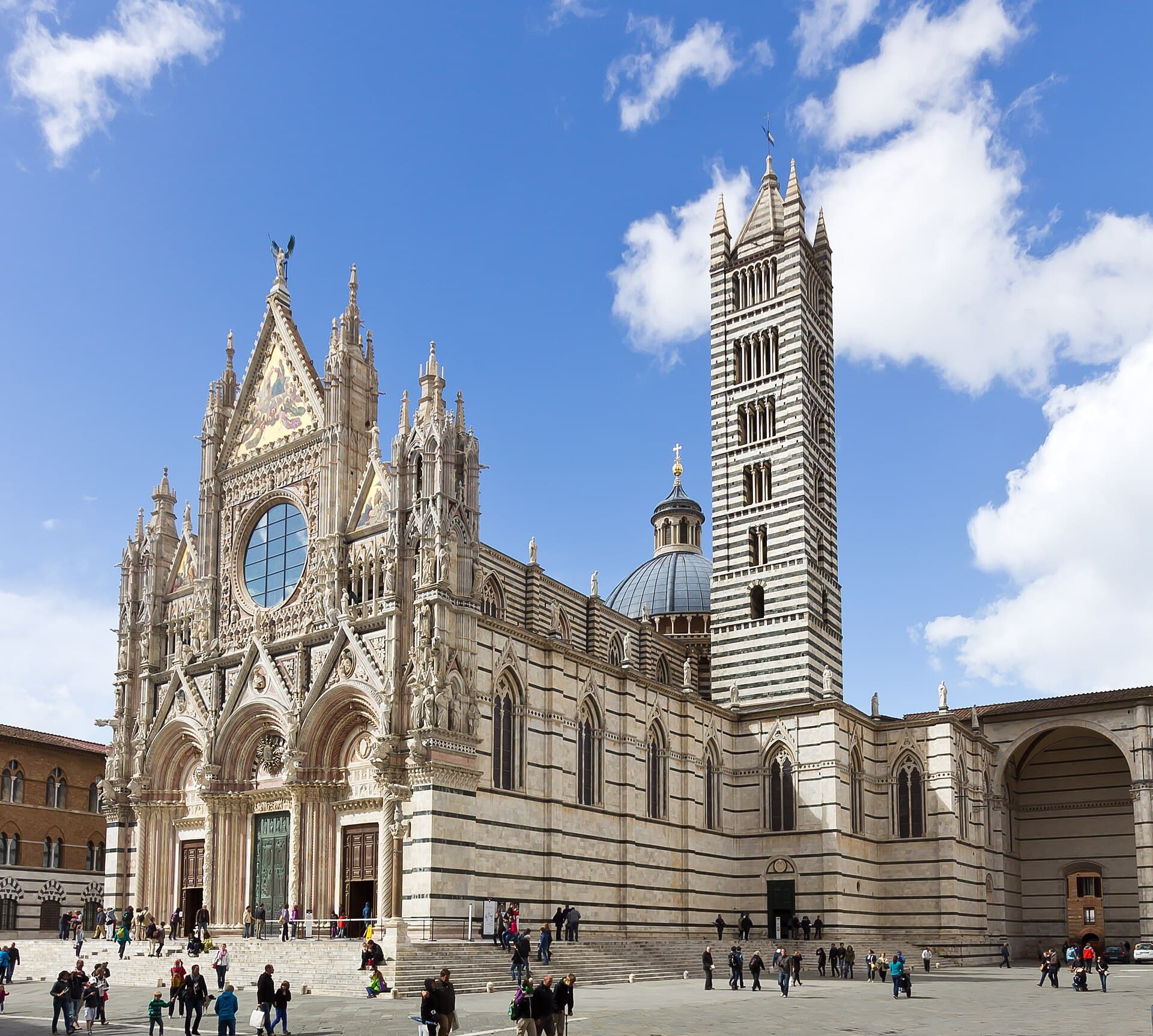 Siena Cathedral**A cathedral striped throughout in black and white marble, its floor fifty-six 3 minutes walk4.9
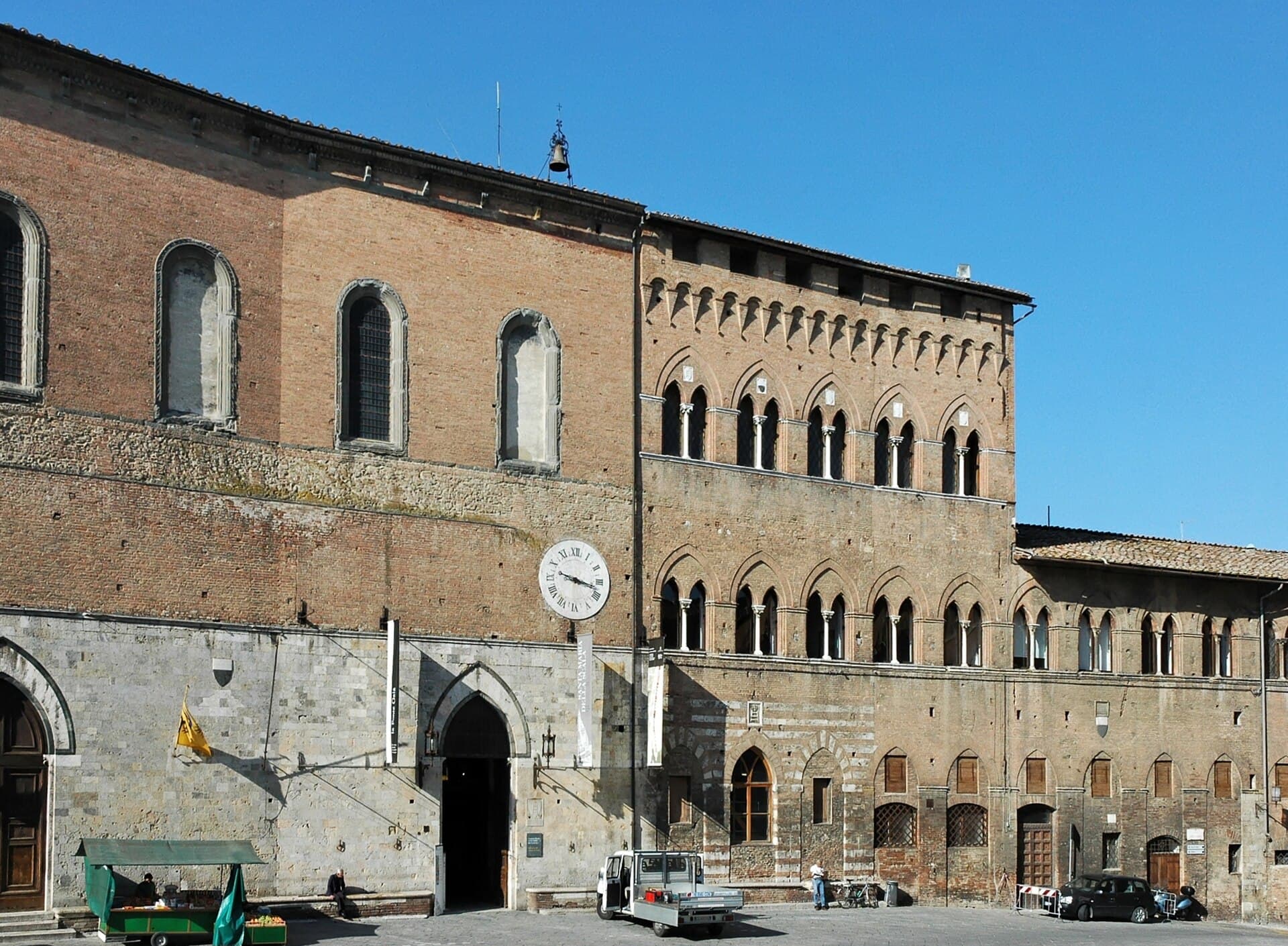 Santa Maria della Scala**One of Europe's oldest hospitals — it worked for a thousand years and is now a3 minutes walk4.7
 National Picture Gallery of Siena**The complete collection of the Sienese school of painting — gold, flat grounds4 minutes walk4.5
**A centuries-old horse race between the city's districts — not a tourist show but a deadly serious local matter.** ✅ **What it is**: a race in which **ten horses** run three laps of the rim of Piazza del Campo **on earth laid down for the purpose** — **and it lasts about ninety seconds**. ✅ **The competitors are the city's districts**: Siena is divided into **seventeen contrade** — historic wards each with **an animal name, an emblem, colours, a church, a museum and an anthem**; **you belong to yours by birth, for life**. **The rivalries and alliances between them are real and old.** ✅ **The two dates**: **2 July** and **16 August** each year. ⚠ **The practical reality**: **standing in the centre of the square is free** — but it means **being packed in for hours under the sun with no way out, no water and no toilets**; **seats and balconies overlooking it sell for large sums and are booked months ahead**. ⚠ **The whole city is full** and prices doubled. ✅ **The celebration runs for days** beforehand: processions, trial races and communal street dinners. ⚠ **The decision**: **if you want to see it, plan months ahead**; **and if you want a quiet Siena, avoid those two weeks entirely**.
**Seventeen historic wards that still organise social life in Siena — not merely neighbourhood names.** ✅ **What they are**: Siena is divided into **17 contrade**, **each with an animal or emblem name**: the Shell, the Tortoise, the Giraffe, the Eagle, the Goose, the Caterpillar, the Unicorn, the Tower, the Forest, the She-Wolf, the Panther, the Dragon, and others. ✅ **How you see them**: **flags, lamps and emblems on the walls** of every lane, **a small baptismal fountain** for each contrada, **and colours painted on the kerbs** — **so the flags tell you which contrada you are walking through**. ✅ **What they mean to their people**: **membership by birth, for life**, unchanged by moving away. **Each has its own church and museum** (displaying the banners of its Palio victories), **its council and its communal dinners**; **and its children are baptised at its fountain**. ⚠ **The rivalry is serious**: each contrada has **a historic enemy** — and losing to them is worse than not winning. ✅ **What it means for a visitor**: **the flags you see are not tourist decoration** — **they are identity**; and respecting that is part of understanding the city.