
The gate in the wall
A Roman arch projecting from a modern hotel front.
Burkhard Mücke — CC BY-SA 4.0 · High Contrast — CC BY 3.0 de · Amrei-Marie — CC BY-SA 4.0 · User:Mattes — Public domain
**The northern gate of the Roman camp** from which Regensburg grew, and one of the **two oldest Roman structures surviving in Germany** — the other being the Porta Nigra in Trier. It was built in **AD 179**, when the emperor **Marcus Aurelius** established the camp of **Castra Regina** here for a full legion, at the northernmost point the Danube reaches — a strategic frontier position on the empire''s edge. What makes it strange today is **where it is**: the gate is **embedded in the wall of a modern building** — a massive stone arch and part of a tower projecting from a hotel front in a narrow street. It was never isolated and nothing around it was cleared; the city grew over and around it across eighteen centuries, and in the nineteenth part of it was uncovered and the rest left as it was. The effect is that you walk down an ordinary lane and find a **Roman wall** standing between residential buildings. Note: **free and always open** — it is part of the street, not a site with a ticket or hours. Note: the visit is short by nature: ten minutes, folded into a walk round the centre.
A Roman arch projecting from a modern hotel front.
Eighteen centuries of building over and around it, legible in the stone.
A residential lane, not an archaeological precinct — half the effect.
Unter den Schwibbögen, Regensburg
 Regensburg Cathedral**The most important Gothic church in southern Germany**, and its twin towers (11 minute walk4.8
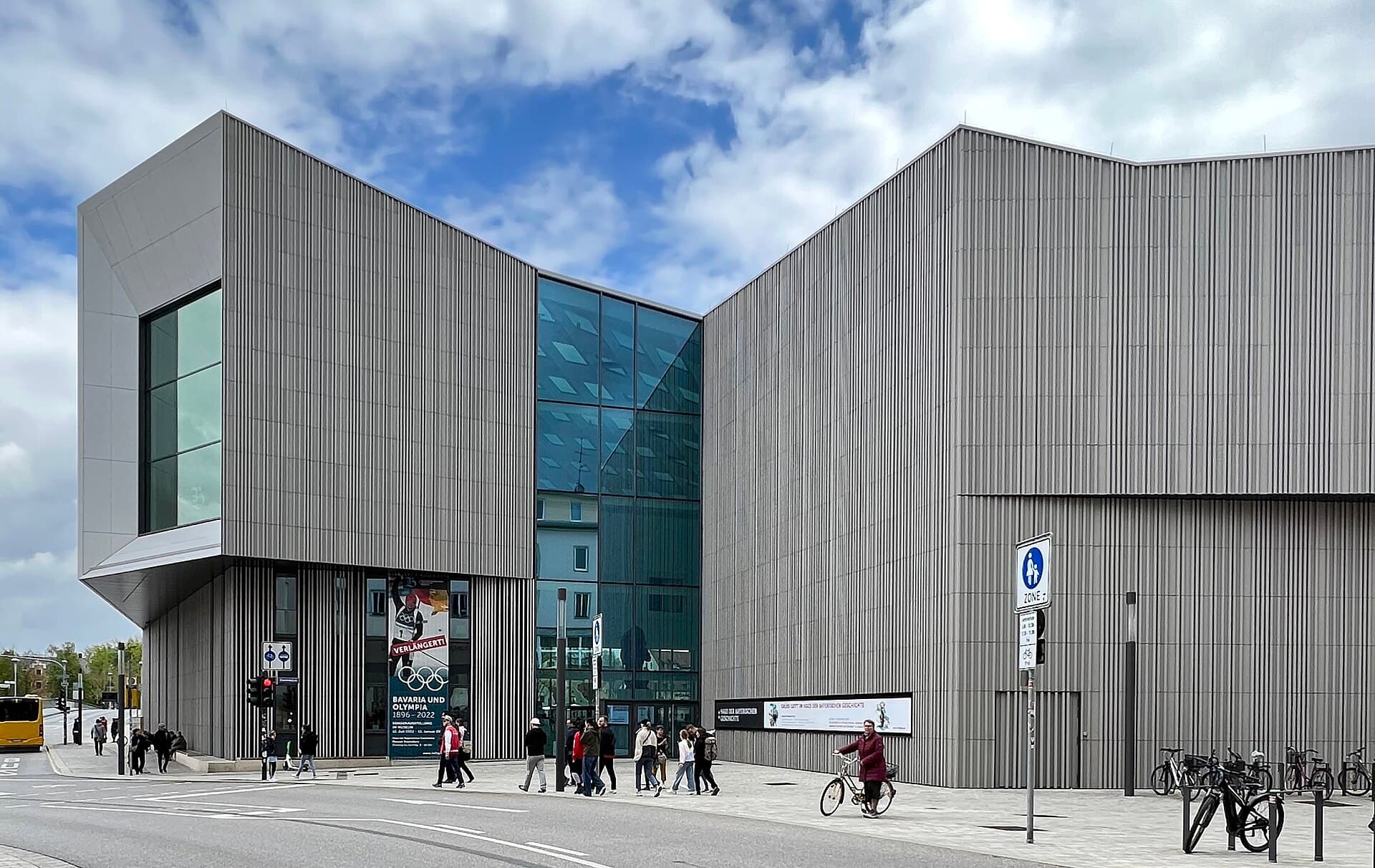 House of Bavarian HistoryA museum of Bavarian history from 1800 to the present, opened in 2019 in a moder3 minutes walk4.5
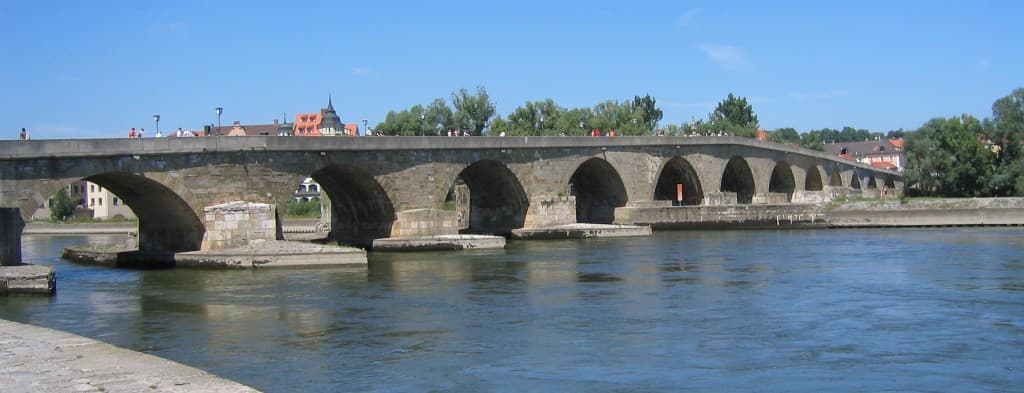 The Stone BridgeA **310-metre** bridge across the Danube, built between **1135 and 1146** — **th4 minutes walk4.8
Far less than in Trier, but parts of it older. The chief piece is the **Porta Praetoria** (AD 179), embedded in a building wall. Alongside it, **sections of the camp wall** appear at scattered points in the centre — some in the cellars of shops and restaurants, visible if you ask. And the **history museum** displays the finds: gravestones of soldiers of the Third Italian Legion, inscriptions and tools. ⚠ The difference from Trier is that Regensburg was a **military camp** rather than an imperial capital, so there are no great baths, no basilica and no amphitheatre — what survives is defensive and domestic. ⚠ But the **continuity** is clearer here: the city has never been abandoned since 179, and the present streets in the centre still follow the camp''s grid.