
The great hall
Three thousand seats beneath Moorish arches and gilded columns — the largest synagogue interior in Europe.
Emmanuel Dyan — CC BY 2.0 · Alexey Elfimov — CC BY 3.0 · Adam Jones, Ph.D. — CC BY-SA 3.0 · Fred Romero from Paris, France — CC BY 2.0
The Dohány Street Synagogue is the largest synagogue in Europe and the second largest in the world, seating around three thousand. It was built between 1854 and 1859 in the Moorish Revival style then fashionable for central European synagogues: twin towers with onion domes, a façade of red and yellow brick in geometric patterns, and an interior of arches and columns that quotes Andalusia openly — architecture entirely familiar to an Arab eye, in the middle of Budapest. The complex is not only a synagogue. In its rear courtyard is an unusual cemetery: Hungarian Jews do not normally bury in synagogue yards, but more than two thousand people who died in the Budapest ghetto in the winter of 1944-45 were buried here, because moving them was impossible. Behind it stands the Tree of Life: a memorial in the form of a metal weeping willow whose leaves are plaques, each inscribed with a victim's name, designed by Imre Varga. The surrounding quarter is the historic Jewish district of Pest, with two further synagogues on a short walking route. The ticket covers the synagogue, the Jewish museum, the cemetery and the Tree of Life memorial; entry is by guided tour at published times, and it closes on Saturdays and Jewish holidays.
Three thousand seats beneath Moorish arches and gilded columns — the largest synagogue interior in Europe.
A metal weeping willow whose leaves are plaques bearing victims' names — among the most powerful memorials in central Europe.
Red and yellow brick in geometric patterns under twin domed towers — an openly Andalusian style, startling in central Europe.
An adjoining building on the site of Theodor Herzl's birthplace, presenting the history and ritual life of Hungarian Jewry.
Dohány utca 2, District VII, Pest 1074
 Raoul Wallenberg Memorial ParkA memorial garden behind Budapest's Great Synagogue, dedicated to the victims of1 minute walk4.5
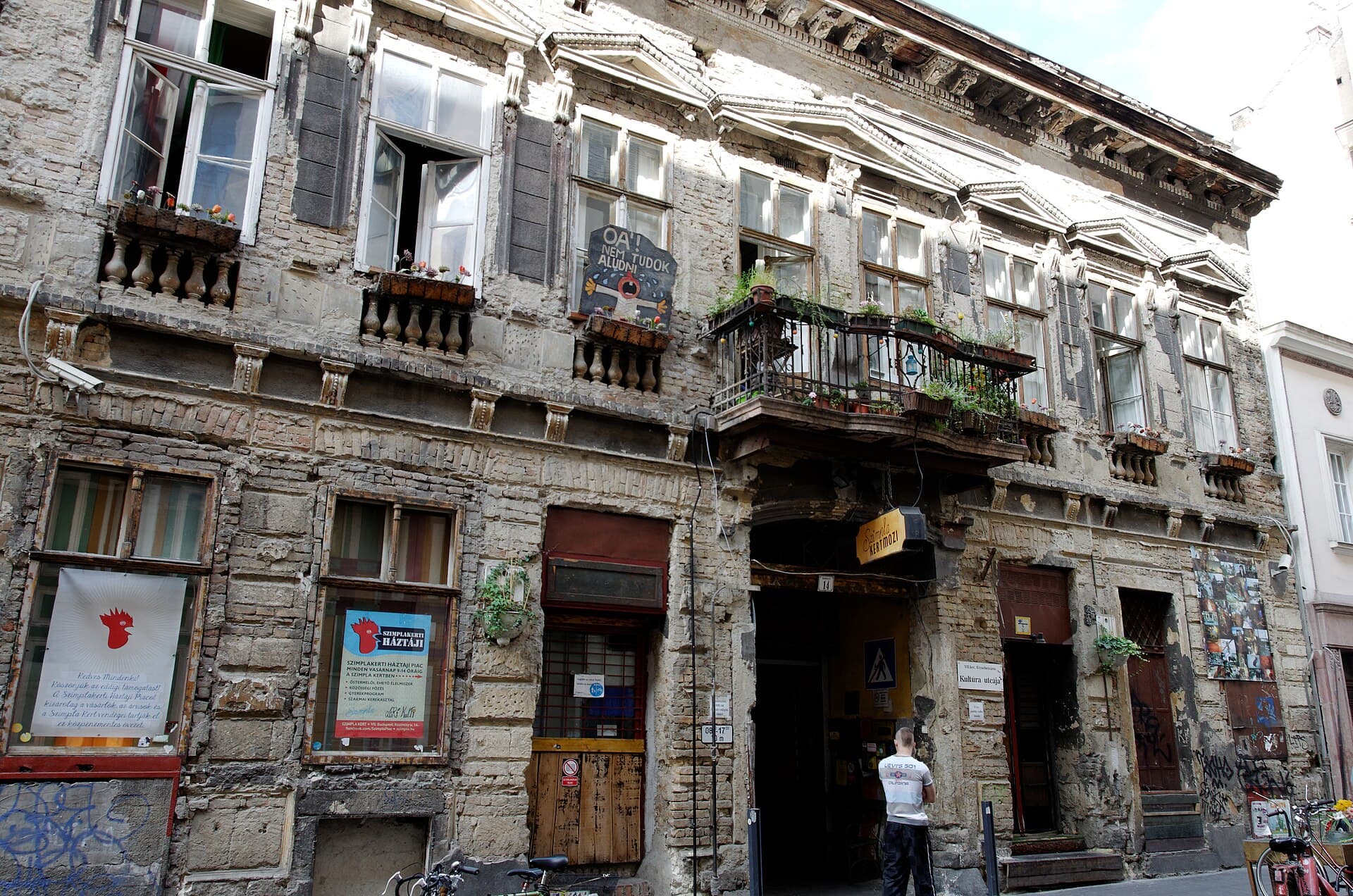 Szimpla Kert (Ruin Bar)The place that invented the "ruin bar": Szimpla Kert opened in 2002 in an abando3 minutes walk4.5
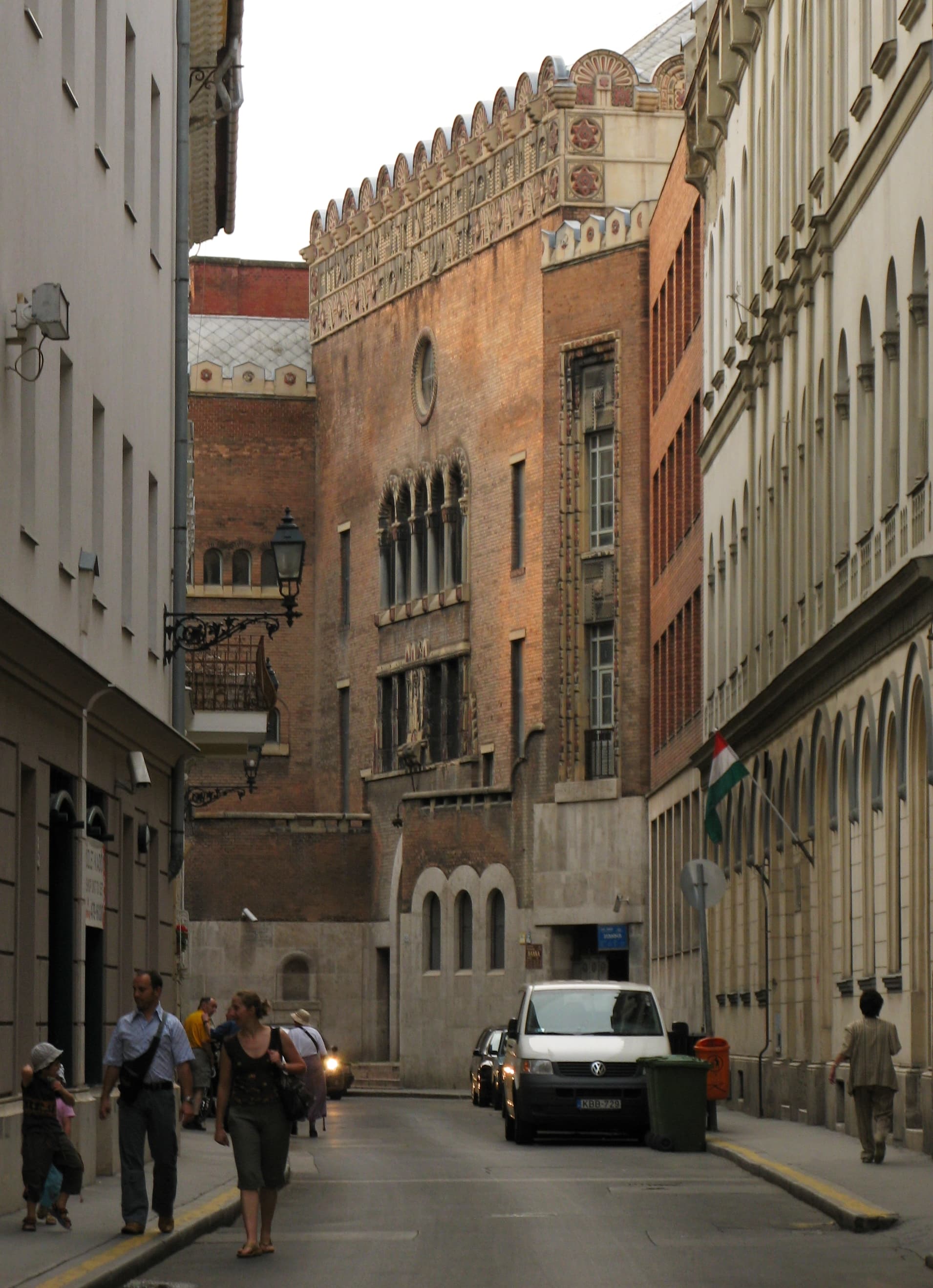
 Rumbach Street synagogueThe Rumbach Street Synagogue is smaller than the nearby Dohány and far less know3 minutes walk4.4
 Kazinczy Street SynagogueThe Kazinczy Street Synagogue is the Orthodox synagogue of District VII, and the4 minutes walk4.5
 Hungarian National MuseumThe Hungarian National Museum is the country's oldest museum and the most import7 minutes walk4.6
Because 19th-century European synagogues adopted Moorish Revival widely: it was seen as an "eastern" idiom expressing Jewish origins without imitating Gothic churches. The result is that the synagogues of Budapest, Prague, Vienna and Berlin share an Andalusian architectural language familiar to an Arab visitor.
It is outside normal Jewish practice. In the winter of 1944-45 the quarter was sealed as a ghetto and the dead could not be taken to the cemeteries, so more than two thousand people were buried in the yard. The graves are a direct trace of those months rather than a religious choice.
It is expensive by Budapest standards, but it covers the synagogue, museum, cemetery and memorial plus a guided tour that supplies the context — and the place does not make sense without it. If 20th-century European history interests you, these are among the most important two hours in the city.
The Rumbach Street and Kazinczy Street synagogues are minutes away on foot, both smaller and quieter. The whole Seventh District walks in two hours, and the Holocaust Memorial Center in southern Pest completes the picture.