
The Poortersloge
The burghers' lodge with its white pointed tower.
User:LimoWreck — CC BY 2.5 · Unknown authorUnknown author — Public domain · Calips — CC BY-SA 4.0 · Calips — CC BY-SA 4.0
Jan van Eyckplein is the heart of the old Hanseatic quarter in northern Bruges — where foreign merchants' ships moored in the fifteenth century and the houses of the traders of Genoa, Venice, Spain and Germany stood: an elegant square on the canal centred on the statue of the painter who lived and worked in Bruges, ringed by the "Poortersloge" (the burghers' lodge with its white pointed tower), the old customs house (Tolhuis) with its worked Gothic façade, and step-gabled houses. Its beauty is its quiet: five minutes from the Markt yet far from its crowds — the quarter around it (Spiegelrei, Sint-Anna, Langerei) holds Bruges' loveliest residential lanes with still canals and bridges, and the walk toward the windmills on the ring canal. This is the Bruges its own people inhabit. Free, and the best start for the quiet northern walk that day-trippers forget.
The burghers' lodge with its white pointed tower.
A worked Gothic façade from the Hanseatic trade era.
The still canal leading into residential Bruges.
Jan van Eyckplein, 8000 Bruges
 Choco-Story (Chocolate Museum)Choco-Story is Bruges' chocolate museum, in a fifteenth-century wine tavern with1 minute walk4.0
 Historium BrugesThe Historium is an immersive experience on the Markt that returns you to Bruges3 minutes walk4.2
 Historic Centre of BrugesThe historic centre of Bruges is the most complete surviving medieval city in no4 minutes walk4.7
 Burg SquareThe Burg is Bruges' second and oldest square: here the Count of Flanders built h4 minutes walk4.8
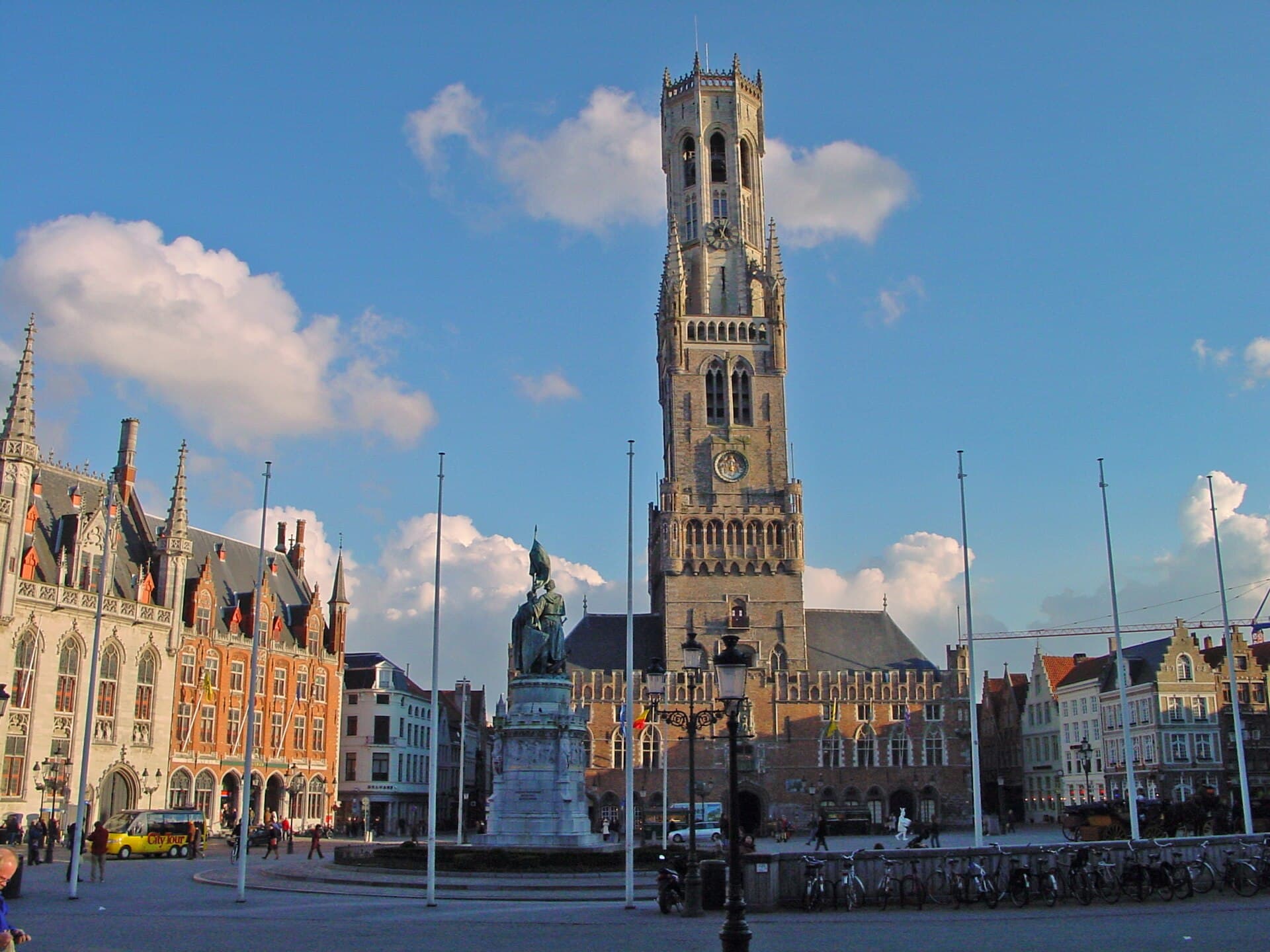 Markt (Market Square)The Markt is Bruges' great square and its beating heart since the tenth century:4 minutes walk4.6
From the square, walk east along the Spiegelrei, then north through the Sint-Anna quarter (the curious Jerusalem Church and the folk museum) to the ring canal with its four windmills (Sint-Janshuismolen can be climbed in summer), and return via the Langerei. Half an hour to an hour without crowds — the real Bruges most miss.