
The staircase
Hundreds of steps climbing the rock face from town to summit.
Jean Housen — CC BY-SA 4.0 · Jean Housen — CC BY-SA 4.0 · Jean Housen — CC BY-SA 4.0 · Jean Housen — CC BY-SA 4.0
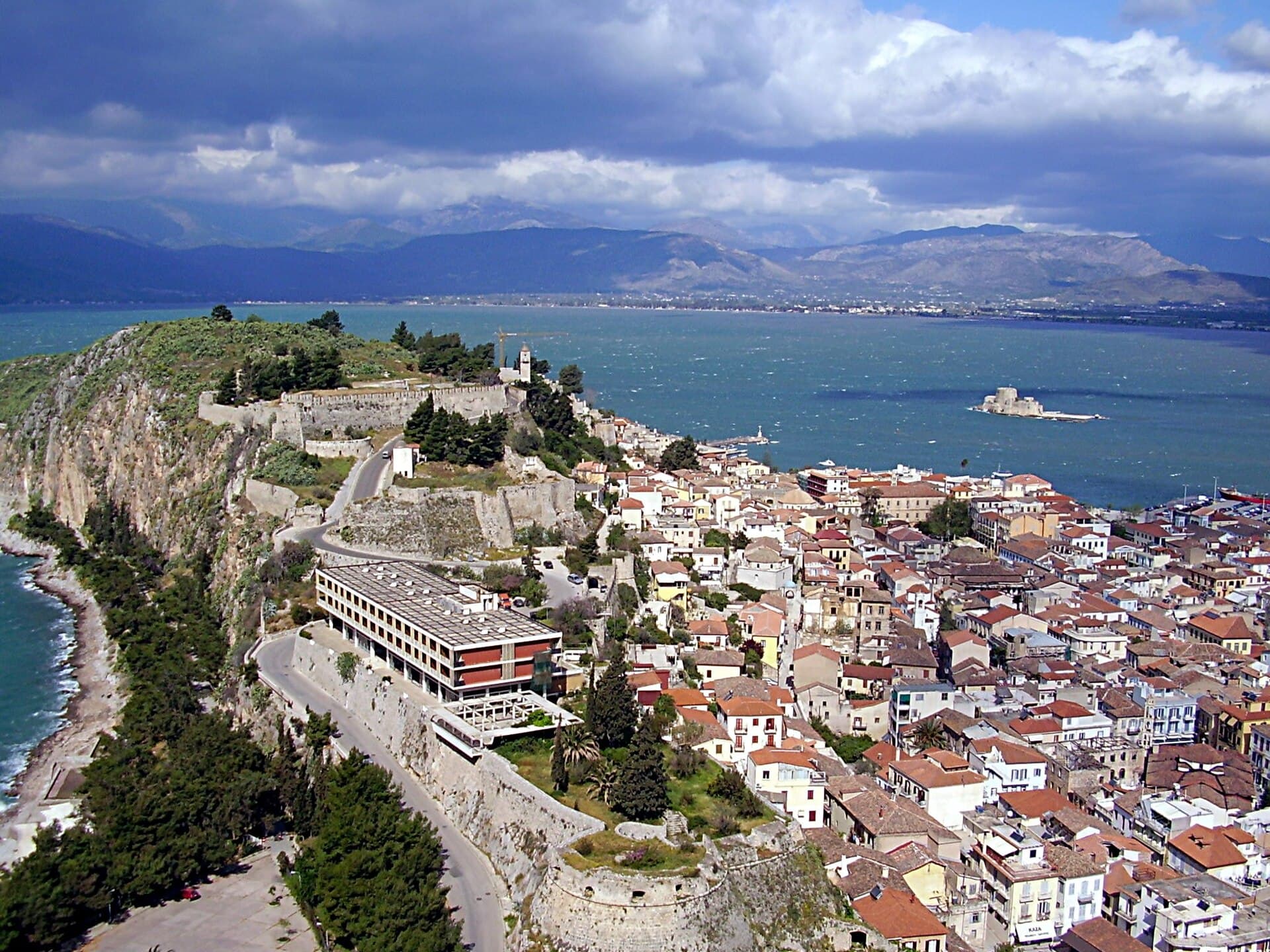
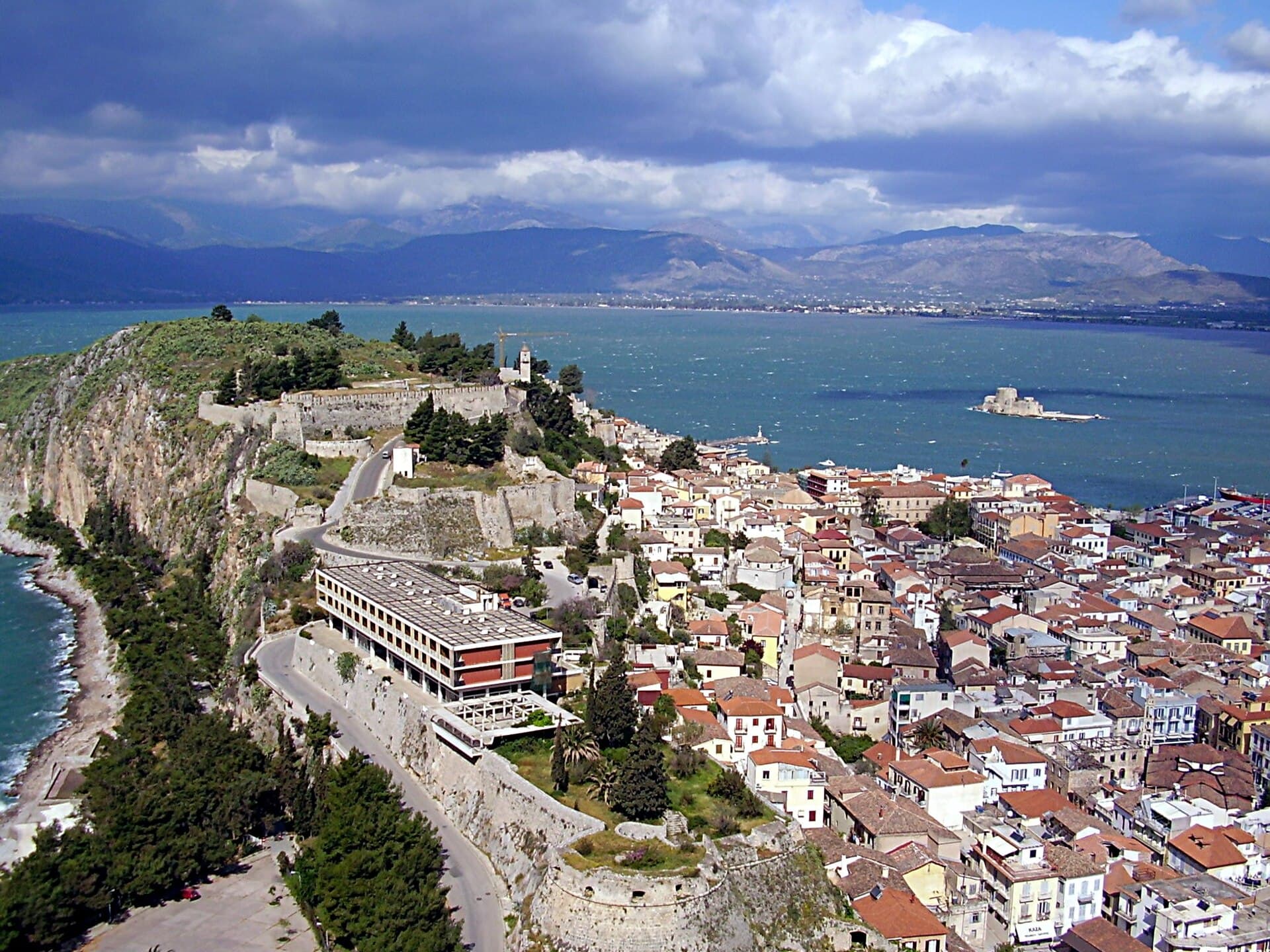
**A Venetian fortress on a rock summit 216 m above the town** — and the thing it is famous for is **the staircase up to it**. The Venetians built it in **1711–1714**, remarkably fast, and it is not one fort but **eight independent bastions** supporting one another, each able to hold out if its neighbour fell — advanced military design for its day. The best known are **Agios Andreas** and **Miltiades**, the latter later used as a **prison**. ⚠ The irony is that the Ottomans took it **one year** after it was finished, in 1715. In the War of Independence it became a symbol: the revolutionaries stormed it in **1822**, and the national hero **Theodoros Kolokotronis** was later imprisoned here in a cell you can still visit. ✅ The view from the top is the finest in the Peloponnese: the whole old town, Bourtzi out in the water, and the Argolic Gulf running to the mountains. ⚠ And the climb on foot is **hundreds of steps** — or you drive to the summit.
Hundreds of steps climbing the rock face from town to summit.
Used as a prison, and holding Kolokotronis's cell.
The old town, Bourtzi and the Argolic Gulf in one sweep.
Palamidi, 21100 Nafplio, Greece
 Nafplio Old Town**The first capital of modern Greece, and the handsomest town in the Peloponnese7 minutes walk4.9
 Acronauplia**The oldest part of Nafplio — four civilisations stacked in a single wall** — o9 minutes walk4.6
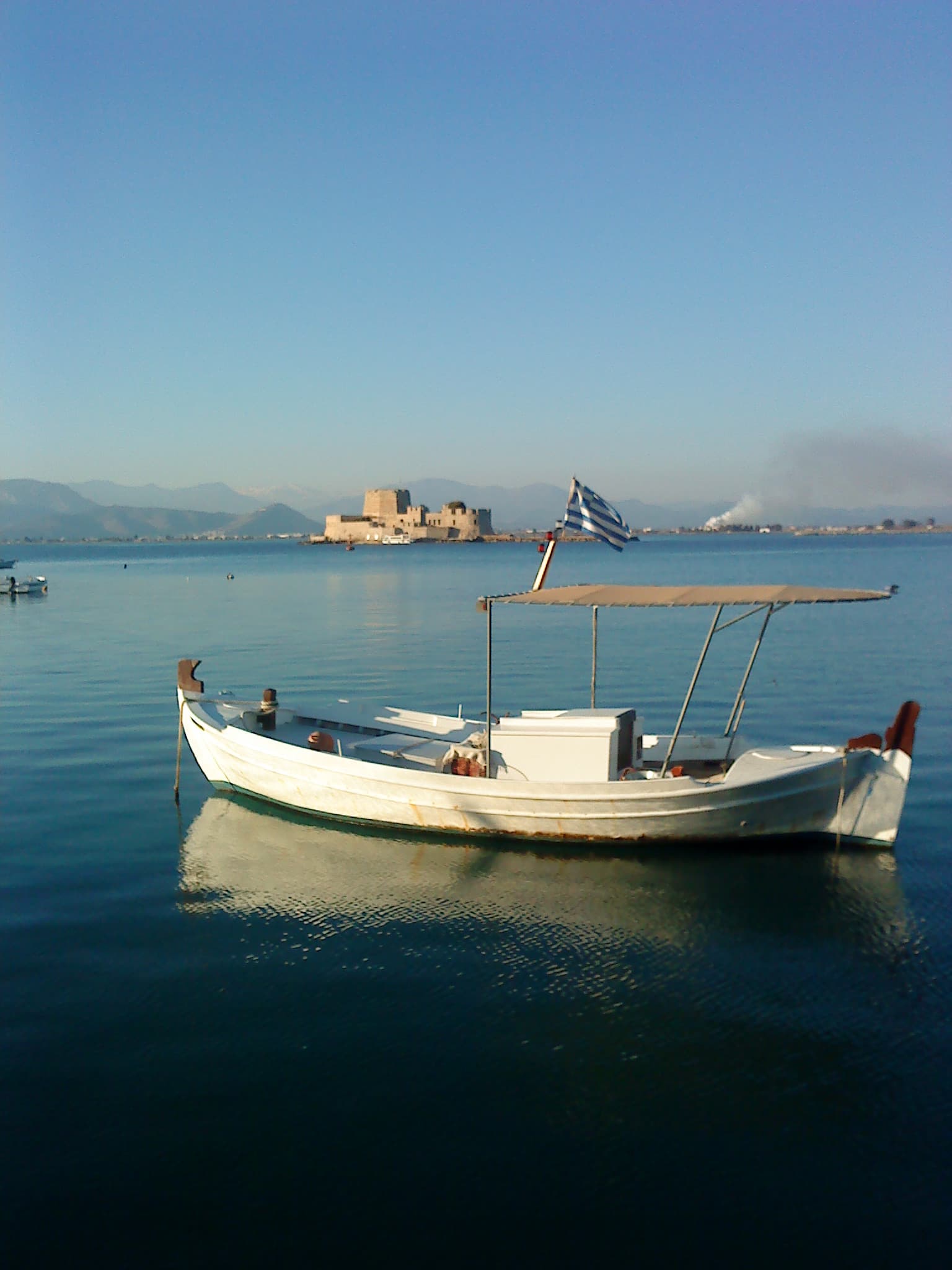 Bourtzi Fortress**A small fortress standing alone on a rocky islet in the harbour** — the symbol19 minutes walk4.6
**A famous figure, but approximate; the real count is lower.** ✅ **What counting gives**: people who actually count usually arrive at around **857** — the discrepancy between counts arises because some short landings and ramps may or may not be counted as steps, and because the staircase has been **restored more than once**. ⚠ **Where does 999 come from?** Largely from local tradition; the difference is sometimes attributed to "the steps Kolokotronis's horse ate" — **an entertaining folk story rather than a historical account**. ✅ **What matters practically is not the number but the effort**: 25–40 minutes of continuous climbing, **with no shade**, on steps of uneven height — and that is what your decision should rest on, not the count. ✅ **A tip**: anyone who wants the experience without the punishment should **take a taxi up and walk down**.
**Palamidi — clearly.** ✅ **Palamidi** is a complete fortress to visit: eight bastions, walls, passages and gates, Kolokotronis's cell, **the best view in the whole area**, and an hour and a half of real content. ⚠ Its drawbacks: the charge, and the climb. ✅ **Acronauplia** is far older (Byzantine, Frankish, Venetian and Ottoman layers stacked on one another), **free**, and closer — reached on foot from town or by a lift on the hotel side. ⚠ But it is **much less rewarding as a visit**: part of it is occupied by a hotel, the remains are scattered and unexplained, and the view is good but inferior to Palamidi's. **The rule:** one slot → Palamidi. Two → Palamidi in the morning one day, and Acronauplia at sunset on another (it is free and close and costs you nothing).