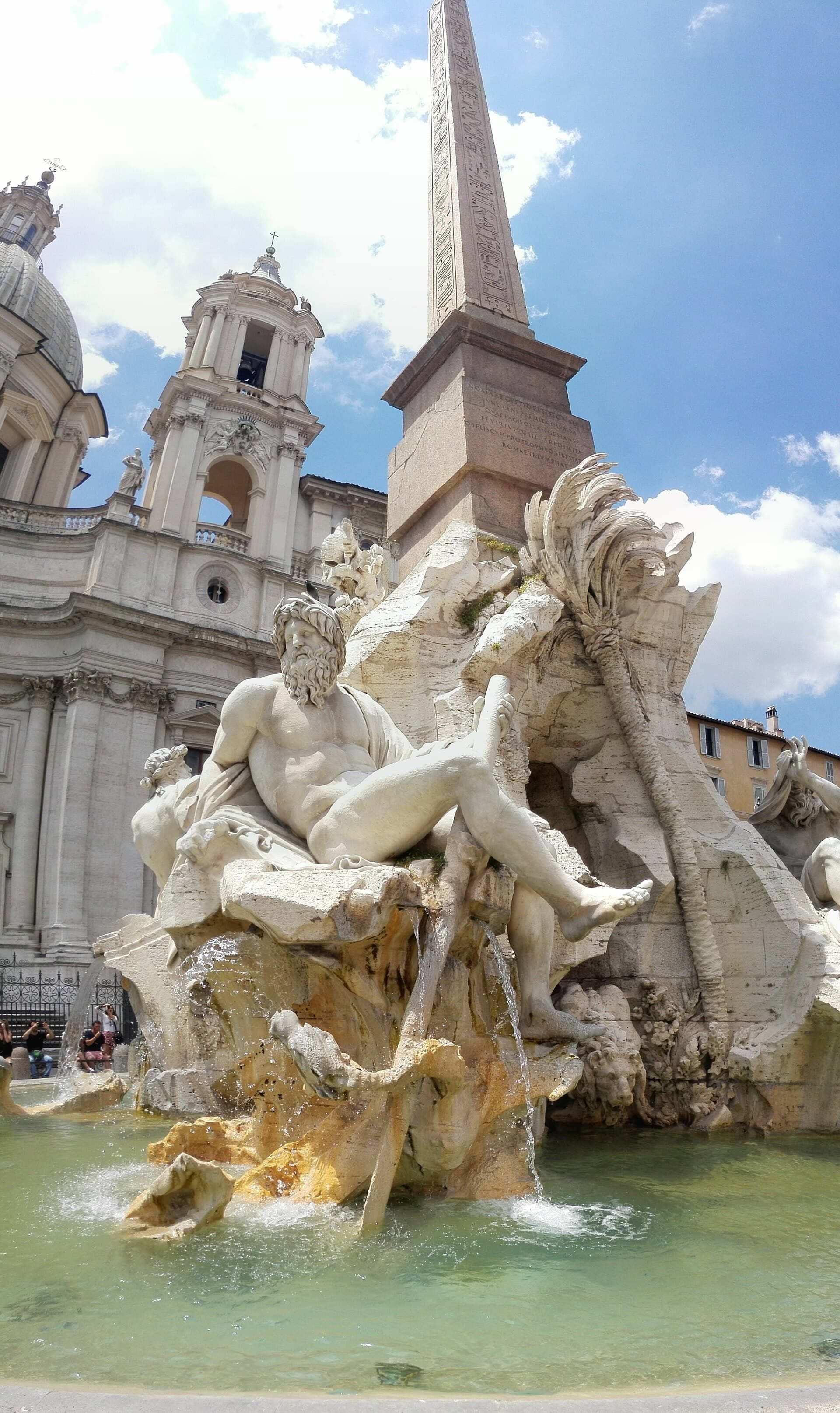
The four giants
Circle the whole fountain: each figure tells a continent through its plants, animals, coins and features.
Fiat 500e — CC BY-SA 4.0 · Sjaak Kempe from Groningen, The Netherlands — CC BY 2.0 · Falk2 — CC BY-SA 4.0 · Paolo Villa — CC BY-SA 4.0
Three fountains punctuate Piazza Navona, and the most famous stands at its centre: Bernini's Fountain of the Four Rivers, carved in 1651. Four marble giants personify the rivers of the then-known continents — the Nile for Africa, the Ganges for Asia, the Danube for Europe and the Río de la Plata for the Americas — seated on a hollowed rock carrying an Egyptian obelisk. Every detail means something: the Nile veils his head because his source was unknown; the Ganges holds an oar because his river is navigable; the Río de la Plata sits among gold coins for New World wealth. A lion, a horse and a palm complete the geographical tableau. At the southern end stands the Fountain of the Moor (a man wrestling a dolphin), at the northern the Fountain of Neptune. All three are free and lit at night. Advice: come early to see the carving without crowds — Bernini cut these details to be read close up, and at midday getting near is impossible.
Circle the whole fountain: each figure tells a continent through its plants, animals, coins and features.
The Nile is said to veil his face in disdain for Borromini's church opposite — a lovely story, though the church came after the fountain.
Two less famous, less crowded fountains at either end — Neptune wrestling an octopus in full motion.
Piazza Navona, Rome
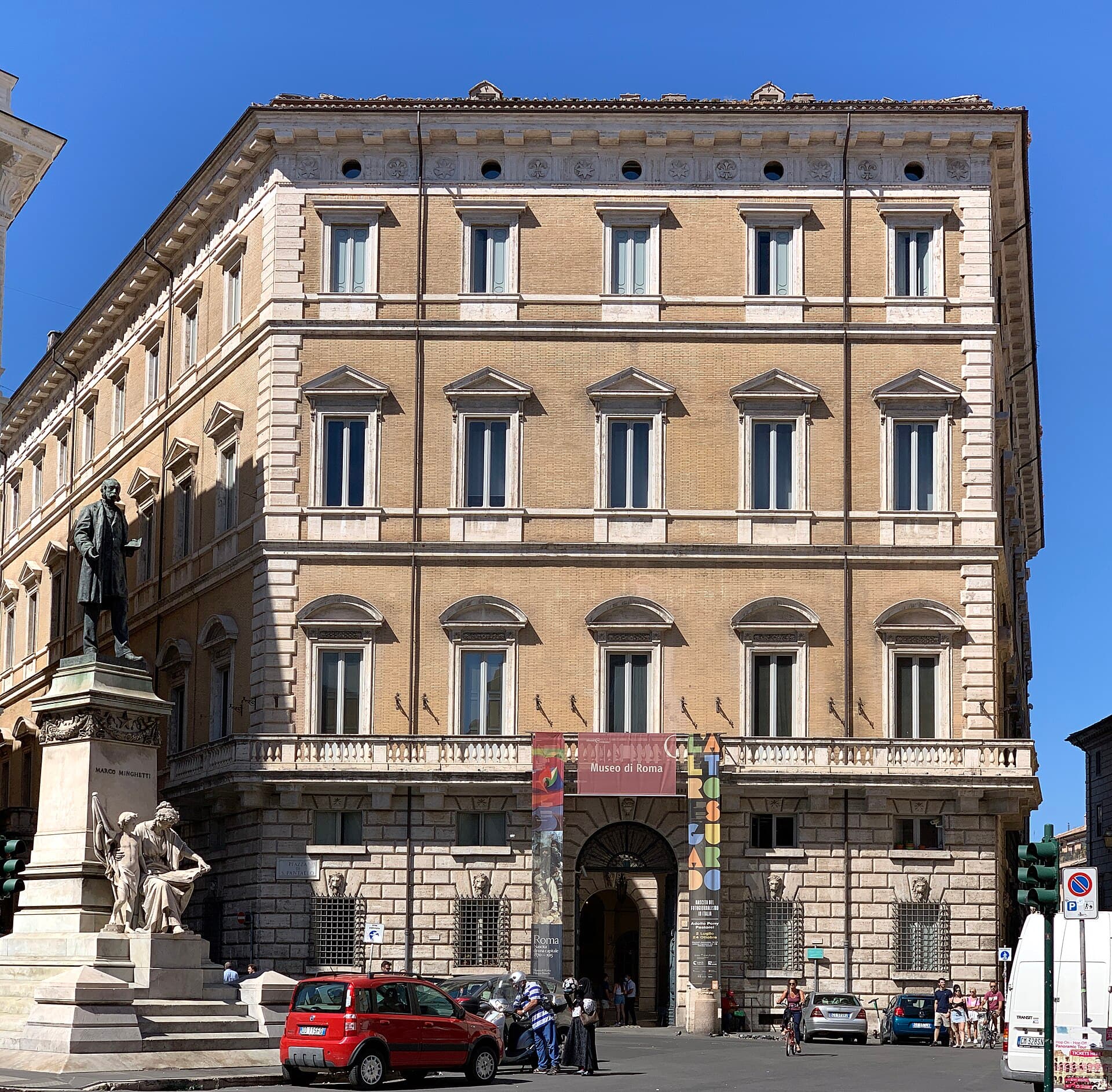 Palazzo BraschiA late eighteenth-century palace on the edge of Piazza Navona, built by Pope Piu1 minute walk4.4
 Piazza NavonaThe square's shape tells its story: a long rectangle with two curved ends, becau1 minute walk4.8
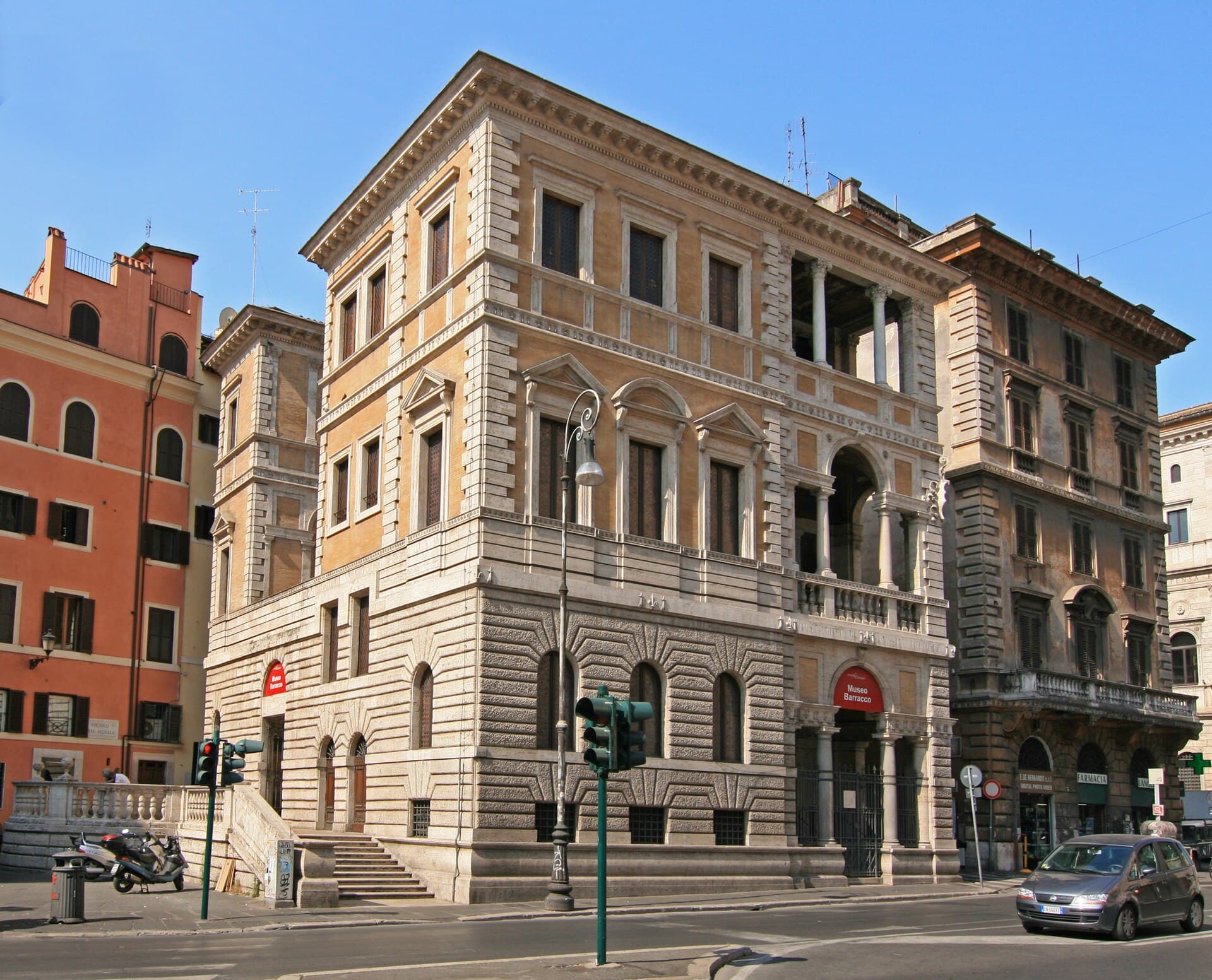 Barracco Museum of Ancient SculptureThe building has been carrying the wrong name for five centuries. Its cornices a2 minutes walk4.5
 Cloister of Bramante (Chiostro del Bramante)The best thing here is not for sale. On the upper floor a small window opens thr3 minutes walk4.6
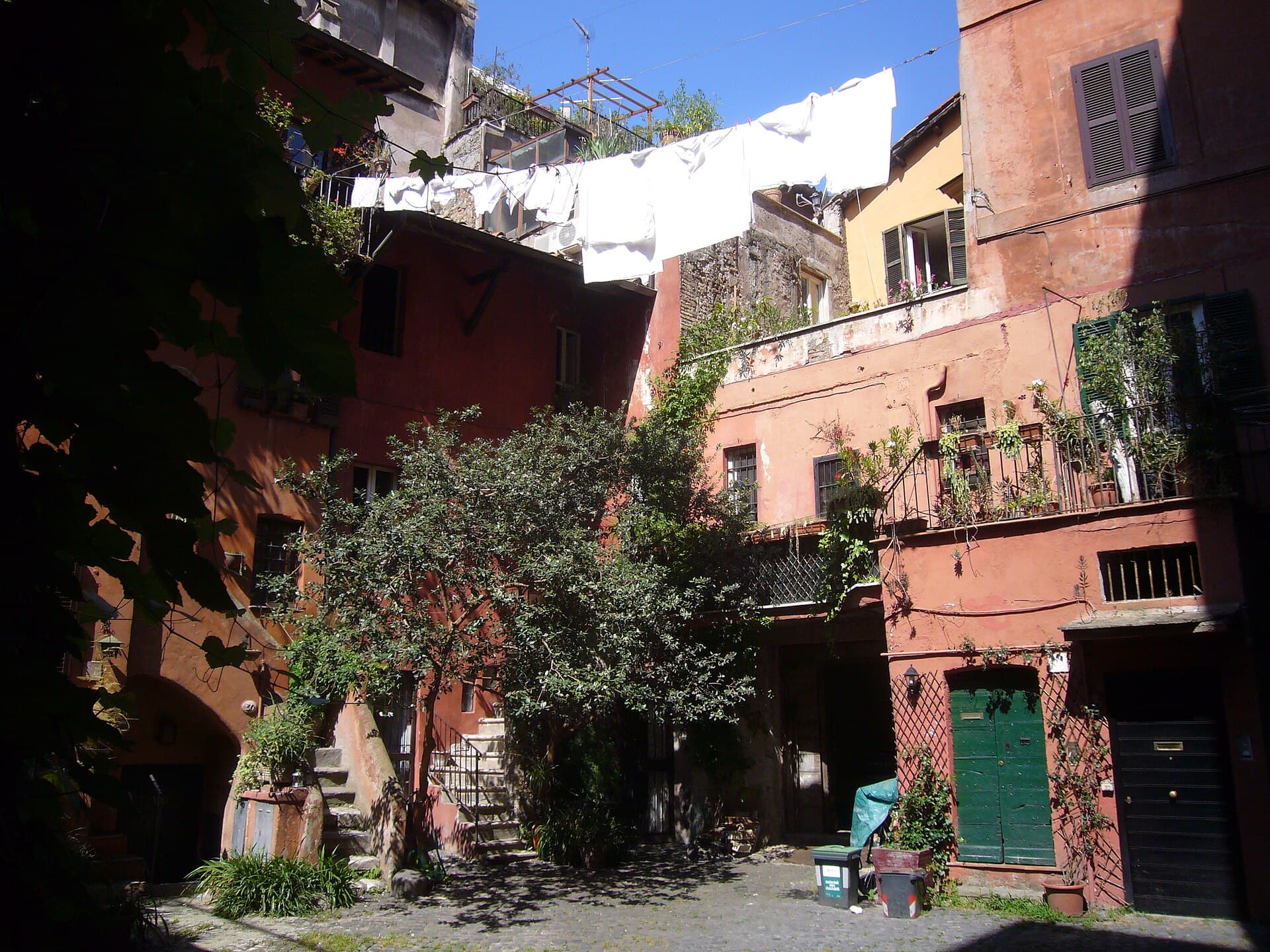 The Arch of the Vinegar MakersA small arch on a side street near Campo de' Fiori, leading to a medieval inner 3 minutes walk4.5
Looking for halal food near Fontana del Moro? There are several options nearby, from Moroccan and Indian kitchens to quick casual spots and places with a view. Confirm the halal status and opening hours before you go — these can change.
The Trevi is larger and more theatrical (an entire palace façade); this is finer carving and richer meaning — four continents in one composition. One is watched; the other is read.