
The western façade
Towering Corinthian columns, visible free from the street.
C messier — CC BY-SA 4.0 · Ad Meskens You are free to use this picture for any purpose as long as you credit its author, Ad Meskens. Example: © Ad Meskens / Wikimedia Commons If you use this work outside of the Wikimedia projec — CC BY-SA 4.0 · Ad Meskens You are free to use this picture for any purpose as long as you credit its author, Ad Meskens. Example: © Ad Meskens / Wikimedia Commons If you use this work outside of the Wikimedia projec — CC BY-SA 4.0 · Ad Meskens You are free to use this picture for any purpose as long as you credit its author, Ad Meskens. Example: © Ad Meskens / Wikimedia Commons If you use this work outside of the Wikimedia projec — CC BY-SA 4.0
In the middle of **Monastiraki**, steps from the metro station and the flea market, stand the remains of the largest building the emperor **Hadrian** raised in Athens, in **AD 132**. The word "library" describes only part of it: it was a complete cultural complex in the Roman manner — a wide inner court with a garden and a pool, ringed by a hundred marble columns, with lecture halls, small theatres and reading rooms, and in the eastern wing the book room, where **papyrus scrolls** were kept in niches cut into the wall, some of which you can still see. Hadrian was **obsessed with Greece** — he learned Greek, grew a beard in the Greek manner, and built more in Athens than any other emperor — and this complex, his arch and the Temple of Olympian Zeus all date from his reign. What stands out today is the **western façade wall** with its towering Corinthian columns on Areos street, and the foundations of Byzantine churches later built inside the same courtyard — a thousand years of layers on top of each other.
Towering Corinthian columns, visible free from the street.
The book room's wall cavities where papyri were kept.
Byzantine churches later built inside the Roman court.
Areos 3, Monastiraki, 10555 Athens
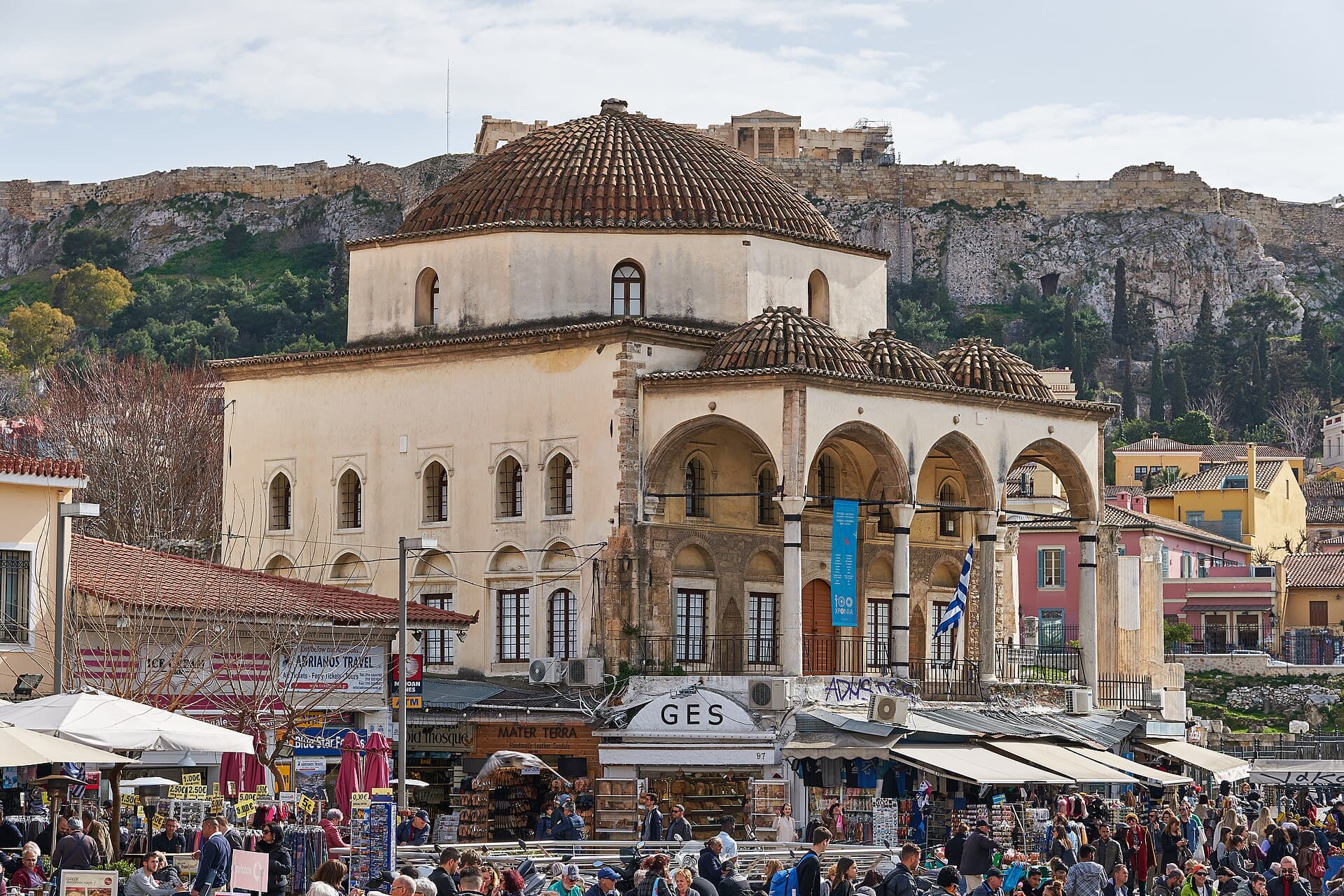 Tzistarakis MosqueIt stands directly on **Monastiraki Square**, and is among the clearest survival1 minute walk4.5
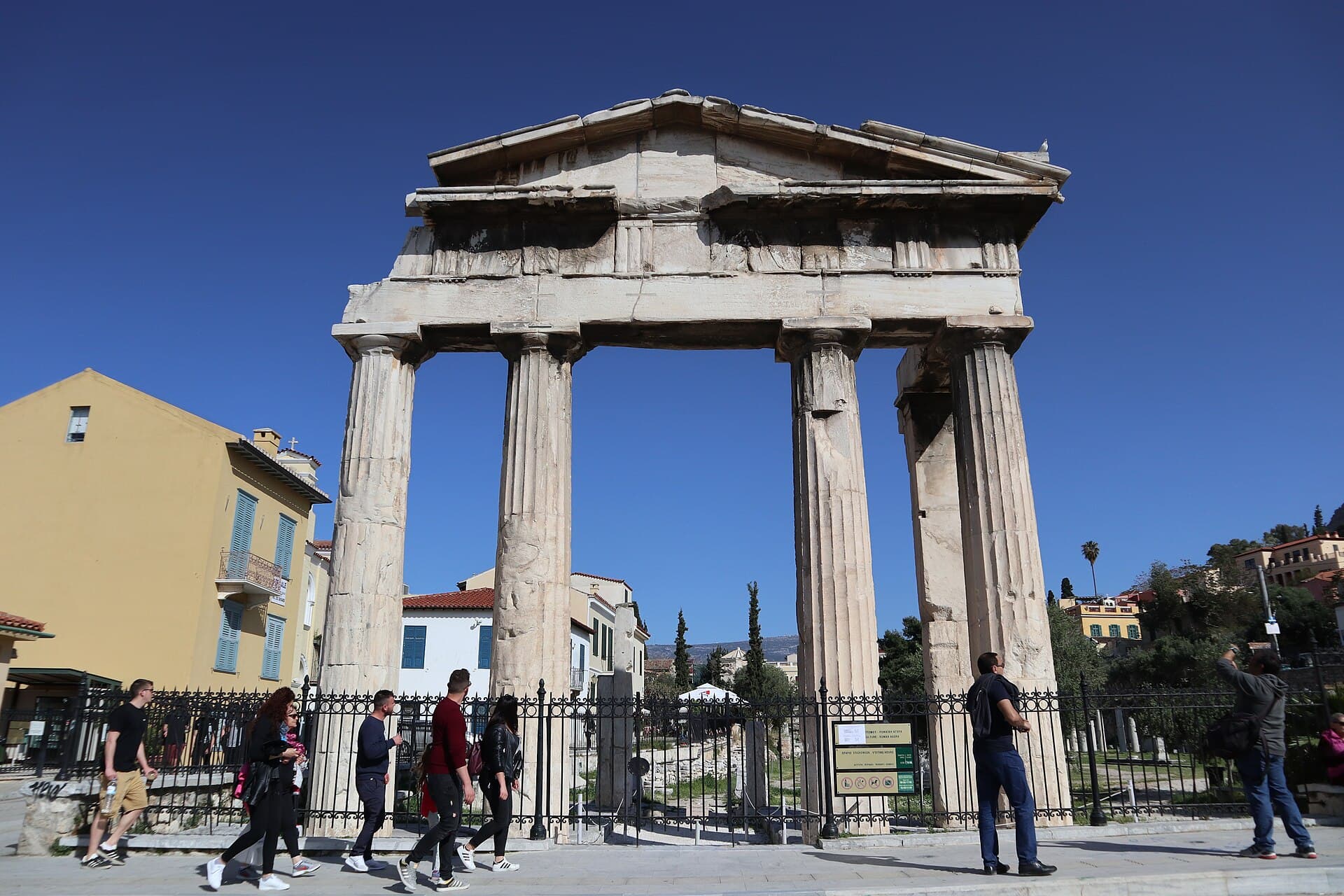 The Gate of Athena ArchegetisA marble gate of four Doric columns at the western entrance to the Roman Agora i1 minute walk4.8
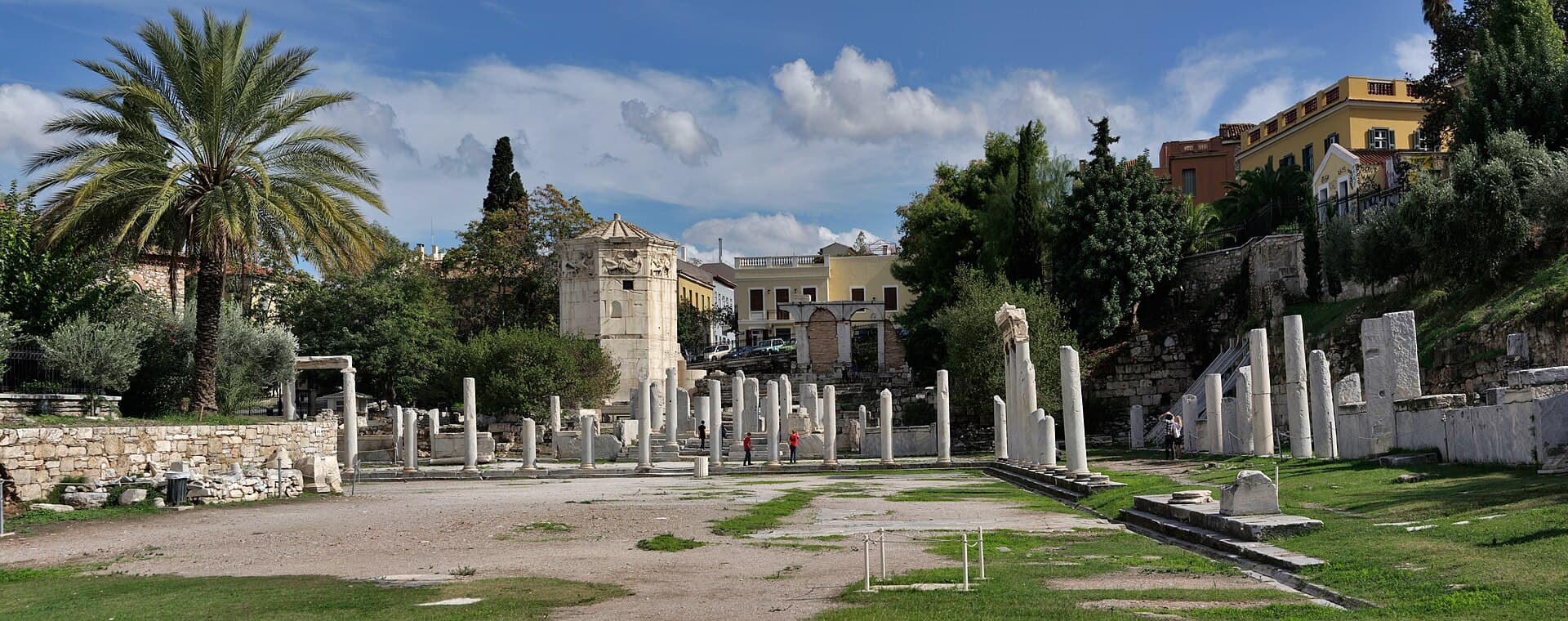 The Roman Agora & Tower of the WindsThe Roman Agora is the market the Caesars built Athens: Socrates' agora grown ol2 minutes walk4.6
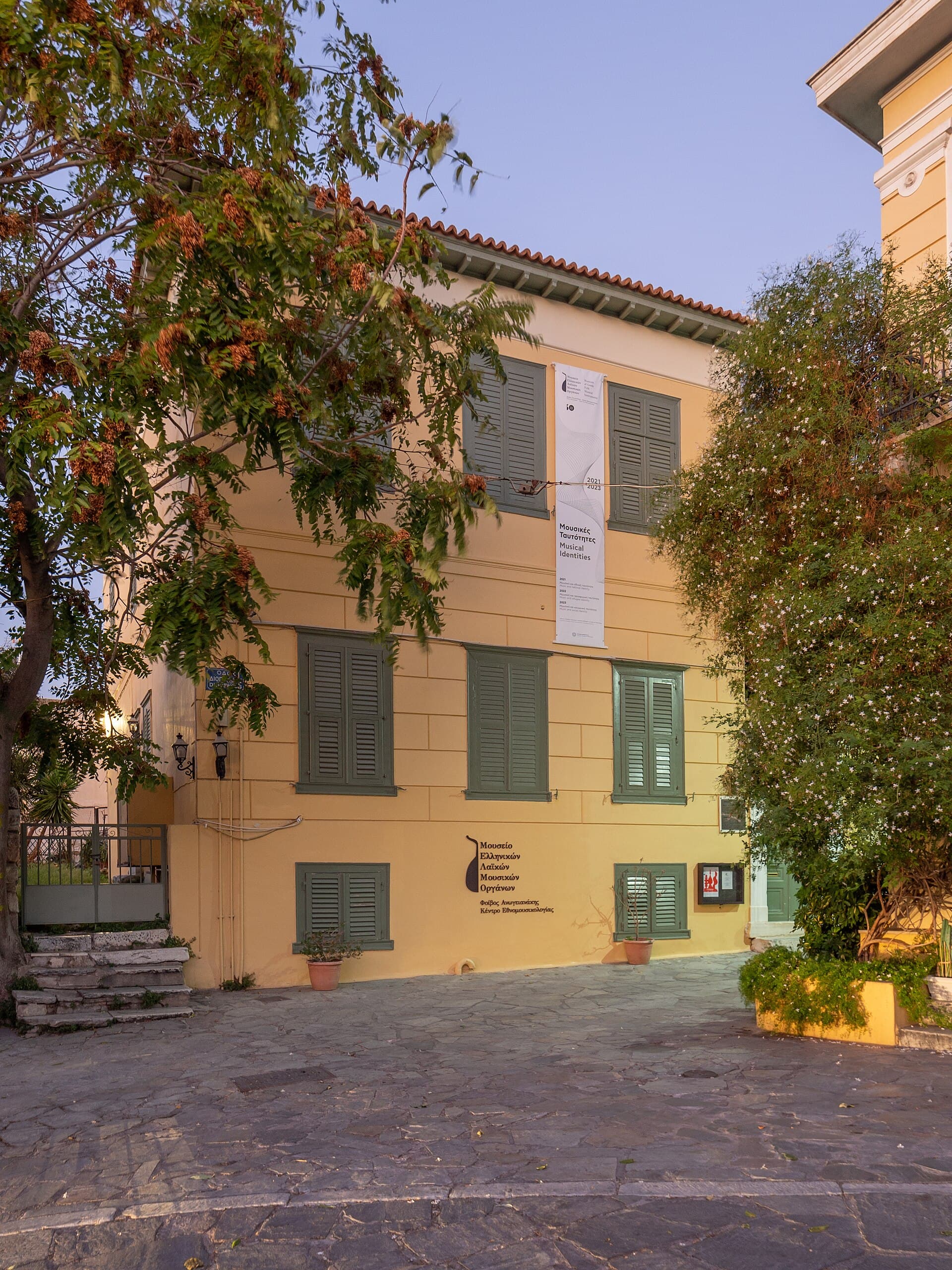 The Museum of Greek Folk Musical InstrumentsA museum in a small nineteenth-century mansion in Plaka showing the collection o2 minutes walk4.5
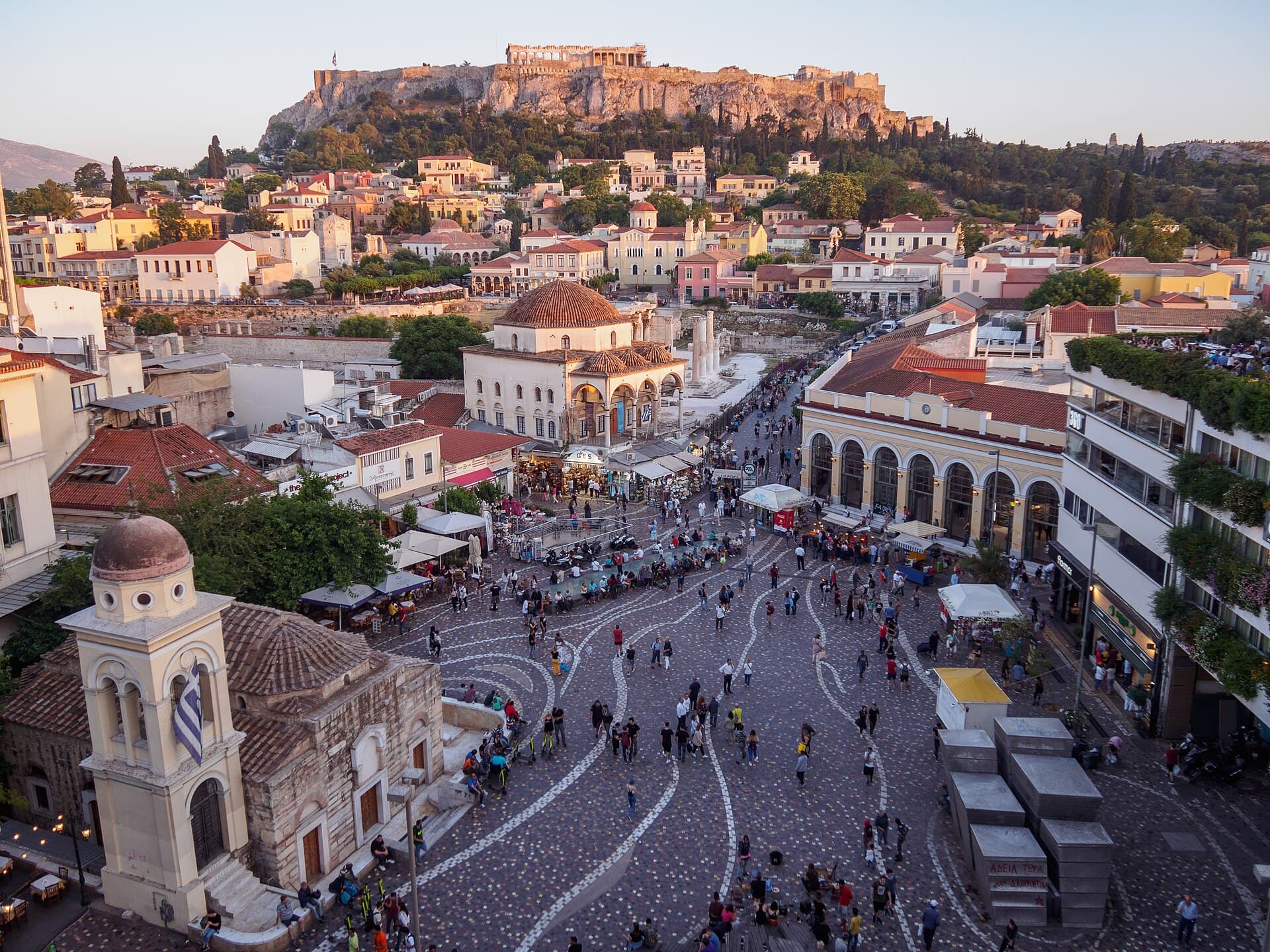 Monastiraki Square & BazaarMonastiraki is people's Athens itself: the square where everything meets — the A3 minutes walk4.4
If you have bought the **combined ticket**, go in without hesitation — entry is effectively free then and the visit takes half an hour. If you would be buying a separate ticket and have one day in Athens, perhaps not: the site is small and mostly **ground-level foundations** that take imagination to read, and its finest feature — the **western façade wall with its columns** — is visible and photographable from the street for nothing. The rule: with the combined ticket, yes; on its own, the Acropolis and the Ancient Agora come first.
They adjoin and are often confused. The **Roman Agora** was the new commercial **marketplace** built by Caesar and Augustus: a square ringed by colonnades and shops, containing the famous **Tower of the Winds** — an octagonal water clock and wind observatory still standing complete. **Hadrian's Library** is a **cultural** complex rather than a commercial one, built a century and a half later. They are two minutes apart and the combined ticket covers both — see them in one hour.